Skip to the main content
3D Body Visualizer

Male reproductive system 3D model: 9 internal organs

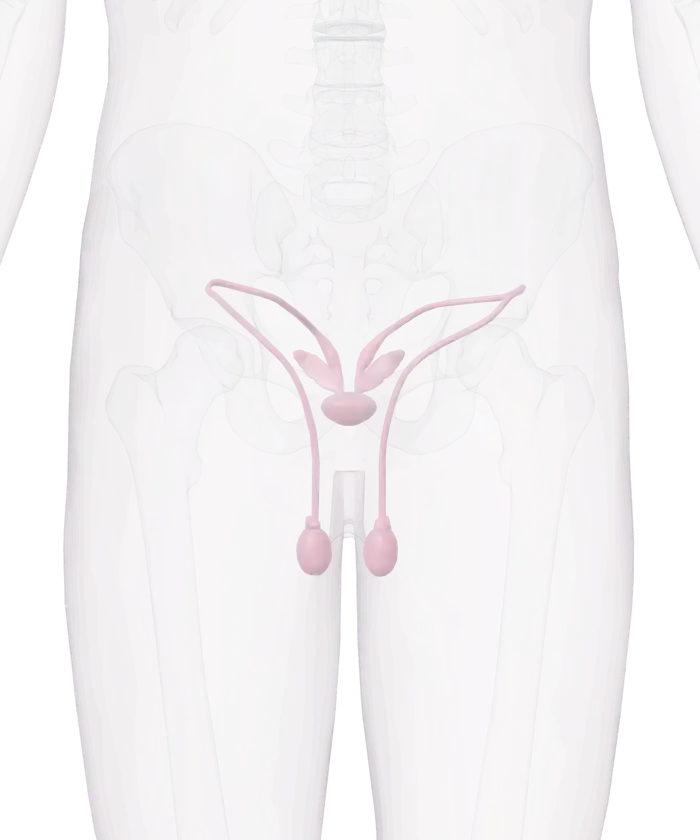
The internal male organs of the 3D anatomy model inside a glass pelvis, seen from the front
FemaleMale

Pick a part

Tap or click a part for its name, a short description and its size. The pelvis is drawn as glass, and a part can be pulled out and turned around.

Reproductive system: 9 parts

Switch a group on or off, or open its list to pick a part by name.

  • Groups in the reproductive system
See the full human anatomy

The model shows the internal male organs of one adult man, from the BodyParts3D project. It has no female organs and no external male organs.

The reproductive system of the model has 9 parts, all of them internal male organs: 2 testes, 2 epididymides, 2 deferent ducts, 2 seminal vesicles and the prostate. The pelvis is drawn as glass around them. The model is one adult male body and has no female organs.

The 9 parts of the model

The 9 reproductive parts of the model are 4 pairs and the prostate.
Part How many Where it sits
Testis 2 Below the pelvis, on each side
Epididymis 2 Along the back of each testis
Deferent duct 2 From each epididymis up and over to the back of the bladder
Seminal vesicle 2 Behind the bladder
Prostate 1 Below the bladder, around the urethra

Each deferent duct of the model spans about 16 cm from its lowest to its highest point. Tap a duct and press Fade the rest to follow its whole course.

What each organ does

The reproductive system has 4 jobs, according to the National Cancer Institute: to make egg and sperm cells, to transport and sustain them, to nurture offspring and to make hormones.

Sperm pass through 5 ducts between the testis and the outside of the body.
Organ What the source says
Testis Oval, about 5 cm long and 3 cm across, with about 250 lobules where sperm are made
Epididymis About 6 meters long when uncoiled; sperm mature and are stored here
Ductus deferens Passes over the ureter and behind the bladder
Seminal vesicles Supply about 60 percent of the volume of semen
Prostate About the size of a walnut; adds a milky, alkaline fluid

The testes hang outside the abdomen, where the temperature is about 3 degrees Celsius below that of the body. The National Cancer Institute notes that sperm need the lower temperature.

Sperm pass through 5 ducts in order: the efferent ducts, the epididymis, the ductus deferens, the ejaculatory duct and the urethra. Three hormones regulate the system: follicle-stimulating hormone, luteinizing hormone and testosterone.

What the model leaves out

The model has no female organs and no external male organs. It does not draw the bulbourethral glands or the ejaculatory ducts. The organs are those of one adult man.

The bladder and the urethra that the ducts run to are in the 3D urinary system. The testes are also endocrine glands, and the other glands are in the 3D endocrine system. The bones of the pelvis are in the 3D skeleton.

The male reproductive organs in the model by name

5 reproductive organs. A part that comes as a left and right pair is listed once.

Male internal organs (5)
  • Deferent duct
  • Epididymis
  • Prostate
  • Seminal vesicle
  • Testis

Sperm travel onward from the tail of the epididymis through the deferent duct (ductus deferens or vas deferens), a muscular tube. It enters the abdominopelvic cavity through the inguinal canal, crosses over the ureter, and descends behind the urinary bladder toward the prostate. There it widens into an ampulla and joins the duct of the seminal vesicle to form the ejaculatory duct.

Along the upper and back edges of each testis lies the epididymis, a tightly coiled tube about 6 meters long that forms a comma-shaped organ. Sperm enter it from the testis while still immature. They finish maturing as they move through the tube, and mature sperm are stored in its lower portion, the tail.

Behind the urinary bladder lie the two seminal vesicles, a pair of sac-like glands. Each has a short duct that joins the deferent duct to form an ejaculatory duct, which empties into the urethra. Their thick fluid contains fructose, an energy source for sperm, and makes up about 60 percent of the volume of semen.

Each testis is an oval organ about 5 cm long and 3 cm in diameter, lying in the scrotum outside the abdominal cavity. Coiled seminiferous tubules inside the testis produce sperm, and cells between the tubules make male sex hormones. The scrotum keeps the testes about 3 degrees Celsius cooler than normal body temperature, as sperm production requires.

The prostate is a firm, dense gland about the size of a walnut, set just beneath the urinary bladder. It encircles the urethra where the urethra leaves the bladder, and many short ducts carry its secretion into that part of the urethra. The secretion is thin, milky and alkaline, and it helps sperm to move.

More to explore

Questions people ask

What is the path of sperm through the male ducts?

Sperm pass through 5 ducts in order: the efferent ducts, the epididymis, the ductus deferens, the ejaculatory duct and the urethra. The model draws the epididymis and the deferent duct on each side, and the deferent duct can be followed from the testis up and over to the back of the bladder.

What does the prostate do?

The prostate adds a milky, alkaline fluid to semen. The National Cancer Institute describes it as about the size of a walnut, below the bladder and around the first part of the urethra. The prostate of the model is 3.4 cm from side to side.

How long is the epididymis?

The epididymis is about 6 meters long when uncoiled, according to the National Cancer Institute. It is packed into a small organ along the back of each testis, where sperm mature and are stored.

Why does the model show no female organs?

The source data is one adult male body, so the model has no ovaries, uterus or other female organs. The reproductive system of the model has 9 parts, all of them internal male organs.

What are the accessory glands of the male system?

There are 3 kinds of accessory gland: the 2 seminal vesicles, the prostate and the 2 bulbourethral glands. The seminal vesicles supply about 60 percent of the volume of semen. The model draws the seminal vesicles and the prostate.

5 sources
  1. Introduction to the Reproductive System, SEER Training Modules, National Cancer Institute. Accessed 14 November 2026.
  2. Testes, SEER Training Modules, National Cancer Institute. Accessed 14 November 2026.
  3. Duct System, SEER Training Modules, National Cancer Institute. Accessed 14 November 2026.
  4. Accessory Glands, SEER Training Modules, National Cancer Institute. Accessed 14 November 2026.
  5. BodyParts3D, Database Center for Life Science (DBCLS), Japan. Accessed 14 November 2026.