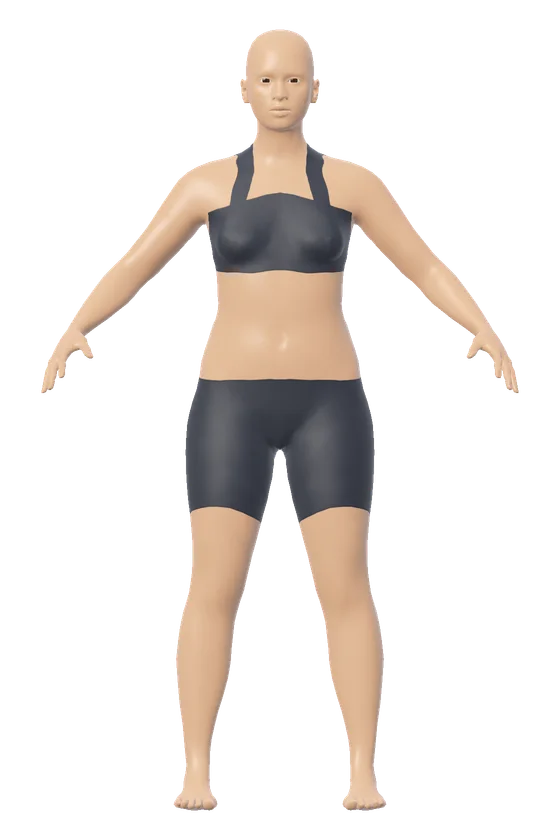
Half your height is the number to remember. NICE is the National Institute for Health and Care Excellence in England. It advises people to keep the waist to less than half the height, which is a waist to height ratio under 0.5. Its guideline NG246 sorts the ratio into three bands, and the calculator names the band for the height and waist entered.
The calculation runs in the browser, and the height and waist entered are not sent to a server.
Worked examples at 165 cm and at 5 ft 7 in
At a height of 165 cm with a 74 cm waist, the ratio is 74 ÷ 165 = 0.45. NICE classes 0.4 to 0.49 as healthy central adiposity. Half of 165 cm is 82.5 cm, so any waist under 82.5 cm keeps this ratio under 0.5.
NICE prints its own example: a 38 in waist at a height of 5 ft 7 in, which is 67 in. Then 38 ÷ 67 = 0.57. In centimeters the same person is 96.5 ÷ 170 = 0.57. That falls in the band NICE calls increased central adiposity. Half of 5 ft 7 in is 33.5 in.
The sum and the same-unit rule
Waist to height ratio = waist ÷ height.
Both numbers must be in the same unit. A height in feet and inches is turned into inches first, so 5 ft 7 in becomes 67 in. The calculator does that step and takes centimeters, or feet and inches, with the waist in centimeters or inches.
A waist exactly half the height gives 0.5, which is the first value of the increased band. The rule is to stay under half, and a waist equal to half does not meet it.
The three NICE bands and who they cover
| NICE band | Ratio | What NICE says it indicates |
|---|---|---|
| Healthy central adiposity | 0.4 to 0.49 | No increased health risks |
| Increased central adiposity | 0.5 to 0.59 | Increased health risks |
| High central adiposity | 0.6 or more | Further increased health risks |
Central adiposity means fat carried around the middle. The health risks NICE names are type 2 diabetes, hypertension and cardiovascular disease.
NICE says the bands can be used for people with a BMI under 35, of both sexes and all ethnicities, including adults with high muscle mass. For a BMI over 35 its committee judged that the ratio may add little, because people at that BMI are always likely to have a high ratio.
The same three bands apply to children and young people aged 5 and over. NICE adds that the evidence for them is weaker than the evidence for adults.
NICE gives no label to a ratio under 0.4. The calculator reports such a ratio as under the point where the bands begin and adds no reading of its own.
The NHS runs its own waist to height calculator and lists who should not use it. The list covers children under 5, anyone who is pregnant and anyone with an eating disorder, diagnosed or suspected. It also covers anyone with a condition that affects height, and adults with a BMI over 35.
Waist limits for heights from 4 ft 10 in to 6 ft 4 in
| Height | Waist at 0.5, half the height | Waist at 0.6 |
|---|---|---|
| 4 ft 10 in (147.3 cm) | 29 in (73.7 cm) | 34.8 in (88.4 cm) |
| 4 ft 11 in (149.9 cm) | 29.5 in (74.9 cm) | 35.4 in (89.9 cm) |
| 5 ft 0 in (152.4 cm) | 30 in (76.2 cm) | 36 in (91.4 cm) |
| 5 ft 1 in (154.9 cm) | 30.5 in (77.5 cm) | 36.6 in (93 cm) |
| 5 ft 2 in (157.5 cm) | 31 in (78.7 cm) | 37.2 in (94.5 cm) |
| 5 ft 3 in (160 cm) | 31.5 in (80 cm) | 37.8 in (96 cm) |
| 5 ft 4 in (162.6 cm) | 32 in (81.3 cm) | 38.4 in (97.5 cm) |
| 5 ft 5 in (165.1 cm) | 32.5 in (82.5 cm) | 39 in (99.1 cm) |
| 5 ft 6 in (167.6 cm) | 33 in (83.8 cm) | 39.6 in (100.6 cm) |
| 5 ft 7 in (170.2 cm) | 33.5 in (85.1 cm) | 40.2 in (102.1 cm) |
| 5 ft 8 in (172.7 cm) | 34 in (86.4 cm) | 40.8 in (103.6 cm) |
| 5 ft 9 in (175.3 cm) | 34.5 in (87.6 cm) | 41.4 in (105.2 cm) |
| 5 ft 10 in (177.8 cm) | 35 in (88.9 cm) | 42 in (106.7 cm) |
| 5 ft 11 in (180.3 cm) | 35.5 in (90.2 cm) | 42.6 in (108.2 cm) |
| 6 ft 0 in (182.9 cm) | 36 in (91.4 cm) | 43.2 in (109.7 cm) |
| 6 ft 1 in (185.4 cm) | 36.5 in (92.7 cm) | 43.8 in (111.3 cm) |
| 6 ft 2 in (188 cm) | 37 in (94 cm) | 44.4 in (112.8 cm) |
| 6 ft 3 in (190.5 cm) | 37.5 in (95.3 cm) | 45 in (114.3 cm) |
| 6 ft 4 in (193 cm) | 38 in (96.5 cm) | 45.6 in (115.8 cm) |
A waist under half the height keeps the ratio under 0.5. A waist at or over six tenths of the height puts it at 0.6 or more. In centimeters the sum is quick. At 170 cm the two lines are 85 cm and 102 cm. At 180 cm they are 90 cm and 108 cm.
Where NICE puts the tape
NICE gives a method for measuring at home:
- Find the bottom of your ribs and the top of your hips.
- Wrap the tape around the waist midway between those two points. NICE notes that this is slightly higher than the belly button.
- Breathe out naturally, then read the tape.
The calculator's waist field uses this site. Use the same site each time you measure, so that one reading can be compared with the next. More on tape technique is in how to take body measurements.
How 0.5 became the boundary
NICE's committee found that the cut-offs reported by individual studies were generally around 0.5, for all ethnicities and both sexes. The committee also noted that 0.5 can be put as a simple message: keep your waist to less than half your height.
Two published reviews point to the same figure. In 2010 Browning, Hsieh and Ashwell brought together 78 studies. The mean boundary values, from studies in 14 countries, were 0.50 for men and 0.50 for women. In 2012 Ashwell, Gunn and Gibson combined 31 papers covering more than 300,000 adults. The ratio picked out adults with cardiometabolic risk factors better than BMI, by 4 to 5 percent on the paper's measure of discrimination. It also did better than waist circumference alone.
Limits of the half-your-height rule
NICE calls the ratio a practical estimate of central adiposity, used to help assess and predict health risks. It is a screening figure and it does not diagnose a condition. NICE advises adults whose ratio indicates an increased risk to seek advice from a healthcare professional.
The ratio needs a true standing height. NICE notes that it can be hard to use for people with some physical disabilities or conditions such as scoliosis. Another measure may then have to stand in for height.
The evidence has gaps. NICE's committee noted a lack of evidence for people of some ethnicities and that few of the studies were based in the UK.
The ratio is used beside BMI in the NICE guideline and does not replace it. The BMI visualizer shows where a height and weight sit among the BMI categories. The two waist measures are set side by side in waist to hip ratio vs waist to height ratio.