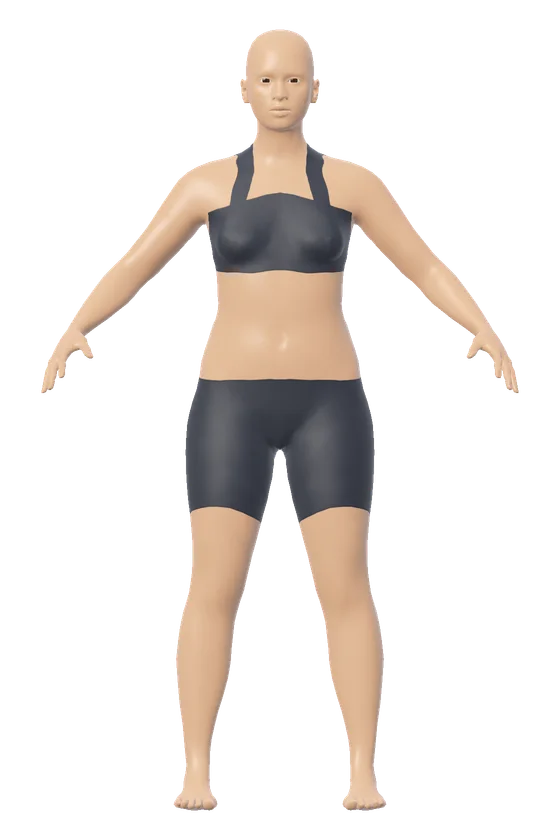
Nine shape names can come out of the calculator, and each one is decided by three subtractions and one division. The rules were written for clothing research. Seven are the formulas credited to Lee, Istook, Nam and Park (2007), as printed by Sokolowski and Bettencourt in 2020. Oval and diamond come from that 2020 paper's extension for bodies whose waist is larger than the hips. Men get the differences between chest, waist and hips without a shape name, because no published standard supplies one.
The measurements are worked out in your browser and are not sent to a server.
A worked example: 38, 28, 35 and 39 inches
Take a bust of 38 in (96.5 cm) and a waist of 28 in (71.1 cm). The high hip is 35 in (88.9 cm) and the hips are 39 in (99.1 cm). Bust minus waist is 10 in (25.4 cm). Hips minus waist is 11 in (27.9 cm). The hips are 1 in (2.5 cm) larger than the bust, and the high hip is 1.250 times the waist.
The hourglass rule has three parts. The bust may be at most 1 in larger than the hips, and here it is smaller. The hips must be less than 3.6 in larger than the bust, and here the gap is 1 in. Then the bust must be at least 9 in larger than the waist, or the hips at least 10 in larger. Both hold, so the calculator answers hourglass. No other rule holds for these numbers.
A single inch can change the answer. Take a 36 in bust, a 33 in high hip and 38 in hips. A 28 in waist leaves the hips exactly 10 in larger, and the result is hourglass. At a 29 in waist the gap is 9 in and the same body is a rectangle.
How the nine rules are applied
Every rule is built from four numbers:
- bust minus hips, or hips minus bust when the hips are larger
- bust minus waist
- hips minus waist
- high hip divided by waist
The published cut-offs are in inches. A measurement typed in centimeters is divided by 2.54 before any rule is tested, so a 22.9 cm difference is read as the 9 in it is. Testing centimeter numbers against 9 would set the bar at 3.5 in instead.
The rules overlap, and the 2020 paper does not say which to try first. The order is the calculator's own. A waist larger than the hips is tested first and gives oval or diamond. The seven older rules follow in the order the paper lists them, and the first one that holds names the shape. The calculator's table marks that rule and shows every other rule that also holds.
The numbers the calculator starts with show an overlap. A 92 cm bust, 74 cm waist, 90 cm high hip and 100 cm hips pass two rules. Hips minus waist is 10.2 in (26 cm), which meets the hourglass test of 10 in. The hips are 3.1 in (8 cm) larger than the bust and the high hip is 1.216 times the waist, which meets the spoon test as well. Hourglass comes first in the order, so hourglass is shown.
Some bodies pass no rule. In one such case the hips are at least 10 in larger than the bust and at least 9 in larger than the waist. If the high hip is also under 1.193 times the waist, no rule holds and the result reads between classes. The 2007 study met the same gap: of more than 6,300 US women, five fit none of its seven shapes.
Every rule in inches and centimeters
| Shape | Rule in inches | Same rule in centimeters |
|---|---|---|
| Hourglass | Bust at most 1 in larger than hips. Hips less than 3.6 in larger than bust. Bust at least 9 in, or hips at least 10 in, larger than waist. | Bust at most 2.5 cm larger than hips. Hips less than 9.1 cm larger than bust. Bust at least 22.9 cm, or hips at least 25.4 cm, larger than waist. |
| Bottom hourglass | Hips 3.6 in to under 10 in larger than bust. Hips at least 9 in larger than waist. High hip under 1.193 times waist. | Hips 9.1 cm to under 25.4 cm larger than bust. Hips at least 22.9 cm larger than waist. High hip under 1.193 times waist. |
| Top hourglass | Bust more than 1 in and less than 10 in larger than hips. Bust at least 9 in larger than waist. | Bust more than 2.5 cm and less than 25.4 cm larger than hips. Bust at least 22.9 cm larger than waist. |
| Spoon | Hips more than 2 in larger than bust. Hips at least 7 in larger than waist. High hip at least 1.193 times waist. | Hips more than 5.1 cm larger than bust. Hips at least 17.8 cm larger than waist. High hip at least 1.193 times waist. |
| Triangle (pear) | Hips at least 3.6 in larger than bust. Hips less than 9 in larger than waist. | Hips at least 9.1 cm larger than bust. Hips less than 22.9 cm larger than waist. |
| Inverted triangle | Bust at least 3.6 in larger than hips. Bust less than 9 in larger than waist. | Bust at least 9.1 cm larger than hips. Bust less than 22.9 cm larger than waist. |
| Rectangle | Bust and hips within 3.6 in of each other. Bust less than 9 in and hips less than 10 in larger than waist. | Bust and hips within 9.1 cm of each other. Bust less than 22.9 cm and hips less than 25.4 cm larger than waist. |
| Oval (apple) | Waist larger than hips. Bust at least as large as waist. | The same: only which girth is larger counts. |
| Diamond (apple) | Waist larger than hips and larger than bust. | The same: only which girth is larger counts. |
The centimeter figures are rounded to one decimal place. The calculator converts with the exact 2.54. The 1.193 is a ratio, so it has no unit. Pear and apple are the everyday names for the triangle and for the two waist-larger shapes. The guide to body shape types describes each shape in turn.
Ten sets of measurements and the shape each one gets
| Bust, waist, high hip, hips in inches | In centimeters | Shape |
|---|---|---|
| 36, 24, 31, 36 | 91.4, 61.0, 78.7, 91.4 | Hourglass |
| 40, 31, 35, 37 | 101.6, 78.7, 88.9, 94.0 | Top hourglass |
| 34, 28, 32, 40 | 86.4, 71.1, 81.3, 101.6 | Bottom hourglass |
| 34, 28, 34, 40 | 86.4, 71.1, 86.4, 101.6 | Spoon |
| 34, 31, 34, 38 | 86.4, 78.7, 86.4, 96.5 | Triangle (pear) |
| 40, 33, 36, 36 | 101.6, 83.8, 91.4, 91.4 | Inverted triangle |
| 36, 29, 33, 38 | 91.4, 73.7, 83.8, 96.5 | Rectangle |
| 42, 40, 40, 39 | 106.7, 101.6, 101.6, 99.1 | Oval (apple) |
| 38, 40, 40, 39 | 96.5, 101.6, 101.6, 99.1 | Diamond (apple) |
| 34, 27, 31, 45 | 86.4, 68.6, 78.7, 114.3 | Between classes |
Two of the sets share a 34 in bust, a 28 in waist and 40 in hips, and differ only in the high hip. With a 28 in waist the line sits at 33.4 in, which is 1.193 times 28. A 32 in high hip gives a bottom hourglass and a 34 in high hip gives a spoon. The best-known set of all has a guide of its own, 36-24-36 measurements.
Where each tape goes
| Measurement | Where the tape goes |
|---|---|
| Bust | Around the fullest part of the bust, with the tape level and not tight. |
| Waist | Around the natural waist, the narrowest level between the ribs and the hips. |
| High hip | Around the upper swell of the hips, over the top of the hip bones. |
| Hips | Around the widest part of the hips and buttocks, with the tape level. |
| Chest (men) | Around the fullest part of the chest, under the arms, with the tape level. |
| Shoulder width (men) | Straight across the back, between the bony points at the outer ends of the shoulders. |
The 2020 paper prints the rules without saying where the high hip tape sits. The calculator uses the upper swell of the hips, between the waist and the fullest part of the hips. The high hip enters two rules only, bottom hourglass and spoon. Height is asked for only to draw the figure, and no rule uses height or weight.
Tape placement changes results. A 2021 study in the journal Ergonomics ran 1,679 body scans through the method with two sets of placement guidance. The same body landed in a different shape in up to 40 percent of cases. Use the same places each time you measure. Each site is described step by step in how to take body measurements.
What exists for men, and what does not
Switch to male and the calculator stops naming shapes. It gives chest minus waist, labeled the drop as in suit sizing, with the hip differences beside it. A 42 in chest, 36 in waist and 40 in hips give a drop of 6 in (15.2 cm). The hips are 2 in (5.1 cm) smaller than the chest and 4 in (10.2 cm) larger than the waist.
No published standard turns a man's chest, waist and hip measurements into a shape name. The research that exists sorts 3D body scans into groups by statistics. A 2020 study of 173 Korean men with abdominal obesity is one example. It used principal component analysis and K-means clustering to form three lower-body groups, each described in words. Work of that kind yields groups for one sample. It offers no tape cut-offs to apply to another person.
Rectangle, triangle, inverted triangle, oval and trapezoid are common names for men's shapes on clothing sites. The cut-offs behind them are each site's own choice, so the calculator leaves the names out and gives the differences as they are. Shoulder width shapes the 3D figure and takes no part in the differences.
What a shape name can and cannot tell you
The rules were built to sort body scans for clothing fit. The 2007 study used them on two national sizing surveys, SizeUSA and SizeKorea, and the 2020 paper used them to study plus-size clothing. No health outcome sits behind any cut-off, so a shape name says nothing about health, body fat or fitness. The waist to hip ratio calculator and the waist to height ratio calculator use cut-offs that health bodies publish.
Rectangle is the most common result in the published samples. The 2007 study found it to be the largest group among both US and Korean women. A 2006 report from North Carolina State University put it at about 46 percent of US women.
The rules have known limits. The 2020 authors found that the 2007 formulas assume a waist smaller than the bust and hips, which is why they added oval and diamond. They also report that the same shape does not hold steadily across a clothing size range. The 3D figure is a model drawn from the girths entered, and its weight is whatever the model needs to reach them. Two people with the same numbers can look different.