Skip to the main content
Body Visualizer 3D

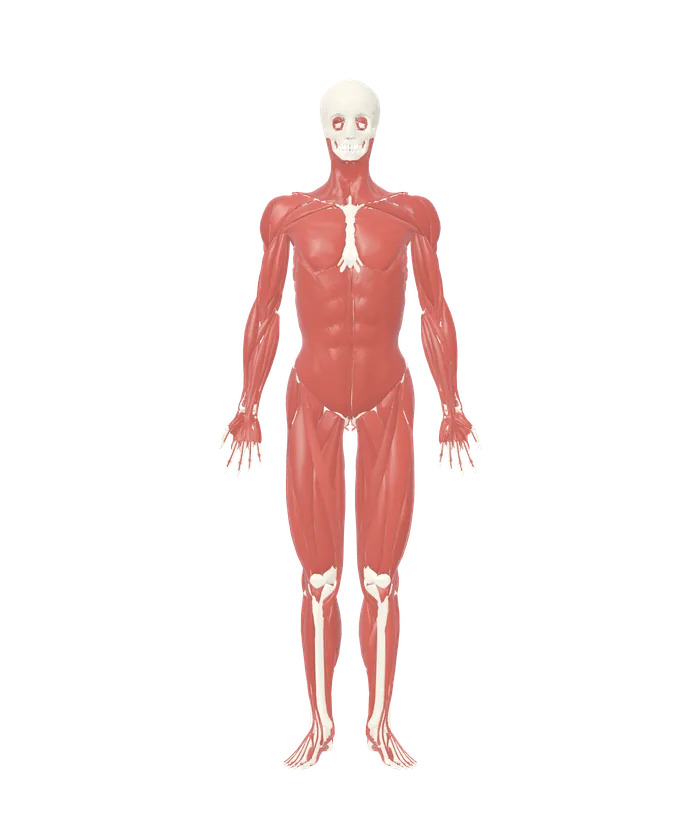
3D muscle anatomy: 422 muscle parts, named

The longest muscle on the model is the sartorius, a 62.6 cm ribbon across the thigh, and it is one of 422 muscle parts that can be tapped and named.

The muscles of the 3D anatomy model, seen from the front

Name the muscle

Ten questions. One part lights up each time: pick its name from four.

Pick a part

Tap or click a muscle for its name, where it starts and ends, and its size. Hide it to see the layer under it, or fade the rest to see it alone.

Body systems

Switch a whole system on or off, or open it to switch its groups and list its parts.

  • Groups in the skeletal system
  • Groups in the muscular system
  • Groups in the cardiovascular system
  • Groups in the nervous system
  • Groups in the respiratory system
  • Groups in the digestive system
  • Groups in the urinary system
  • Groups in the reproductive system
  • Groups in the endocrine system
  • Groups in the lymphatic and immune system
  • Groups in the eye and ear
  • Groups in the skin and hair

The muscles are those of one adult man, from the BodyParts3D project. The muscles of the face and four muscles of the trunk are missing from its data. Build differs widely between people.

There are more than 600 muscles in the body, and together they account for about 40 percent of a person's weight (National Cancer Institute, SEER training modules). The body on screen carries 422 muscle parts laid over its skeleton. Tap any of them for its name, where it starts and ends, and what it moves.

Muscle parts by region

The arm and shoulder have the most muscle parts in the model, 124, and the trunk the fewest, 78.
Region Parts Different names Examples
Head and neck 100 51 Sternocleidomastoid, digastric, the six muscles that turn each eye
Trunk 78 41 Diaphragm, external oblique, psoas major, the muscles between the ribs
Shoulder, arm and hand 124 49 Deltoid, biceps brachii, triceps brachii, supinator
Hip, leg and foot 120 56 Gluteus maximus, sartorius, gastrocnemius, soleus

A part is one separate piece of the model. Left and right are separate parts, and so are the heads of a muscle: the triceps brachii has three on each arm. Counting each name once gives 197 names across the body.

Several large muscles come in pieces that can be told apart. The deltoid, the pectoralis major and the trapezius are each in three parts. The triceps has its long, lateral and medial heads, and the biceps brachii, the biceps femoris and the gastrocnemius have two heads each. A few tendons and bands sit with the muscles too, among them the calcaneal tendon at the heel and the iliotibial tract down the outside of the thigh.

The shoulder, one part at a time

Tap the cap of the shoulder. The card names one of the three parts of the deltoid: the clavicular part at the front, the acromial part over the point of the shoulder or the spinal part behind. All three share one description, taken from Gray's Anatomy: the fibers start from the clavicle, the acromion and the spine of the scapula, and converge on the outer side of the humerus.

Press Fade the rest and the chosen part stands alone in a glass body. Press Hide it and the part is gone, which uncovers what lies beneath. Do the same with the other two parts and the muscles under the deltoid show, around the top of the humerus. Reset brings every part back.

Whole regions come and go the same way. Under Muscular system, the switch for Shoulder, arm and hand removes all 124 parts at once and leaves the arm bones.

What the names say

Vastus, the word for huge, names three muscles of the thigh in the model.
Word Meaning In the model
Vastus Huge Vastus lateralis, vastus medialis, vastus intermedius
Maximus Large Gluteus maximus
Longus Long Adductor longus, fibularis longus, palmaris longus
Brevis Short Adductor brevis, fibularis brevis
Deltoid Triangular Deltoid
Teres Round Teres major, teres minor
Rectus Straight Rectus femoris
Oblique Diagonal External oblique
Brachii Of the arm Biceps brachii, triceps brachii
Gluteus Of the buttock Gluteus maximus, gluteus medius, gluteus minimus

The meanings are those given in the National Cancer Institute's training module on muscle groups. Type any of the words into the search box and every muscle that carries it is listed, left and right.

Long muscles and short ones

The sartorius measures 62.6 cm from top to bottom on this body. Gray's Anatomy calls it the longest muscle in the body. The rectus femoris, on the front of the thigh, comes to 55.6 cm and the gracilis, on the inner side, to 51.3 cm. Along the back, the longissimus thoracis runs for 52.0 cm beside the spine.

Small muscles are here too, in the larynx and around the eye. Switch off the skeleton and zoom in on an eye socket: six muscles turn each eyeball and a seventh, the levator palpebrae superioris, raises the upper eyelid.

Ten questions on 66 muscles

Start the quiz and a muscle lights up on one side while the rest of the body turns to glass. Where a muscle has several heads, all of them light together, so the question is about the biceps and not about one head of it. Four names are offered, drawn from the same region where possible.

The view closes in on the muscle, and the body still turns. A side or back view often settles the answer, since some muscles show only from behind. The bone quiz on the 3D skeleton follows the same pattern.

Gaps in the muscle layer

The data behind the body has no muscles of the face or of chewing. Four trunk muscles are missing: latissimus dorsi, rectus abdominis, internal oblique and transversus abdominis. The front of the abdomen is therefore partly open, and the back shows deeper muscles than a real back would.

Of the 422 parts, 417 have a written description. The body is one adult man, and the size and shape of muscles differ widely between people. The full 3D anatomy view adds the organs, vessels and brain to the same body, and the 3D body visualizer shows how build changes a figure's outline.

Every muscle part in the model by name

217 muscles, heads and tendons. A part that comes as a left and right pair is listed once.

Head and neck (54)
  • Aryepiglotticus
  • Digastric
  • Genioglossus
  • Geniohyoid
  • Hyoglossus
  • Inferior oblique
  • Inferior oblique part of longus colli
  • Inferior pharyngeal constrictor
  • Inferior rectus
  • Intermediate tendon
  • Lateral crico-arytenoid
  • Lateral rectus
  • Levator palpebrae superioris
  • Levator veli palatini
  • Longus capitis
  • Medial rectus
  • Middle pharyngeal constrictor
  • Mylohyoid
  • Oblique arytenoid
  • Oblique part of cricothyroid
  • Obliquus capitis inferior
  • Obliquus capitis superior
  • Omohyoid
  • Palatopharyngeus
  • Pharyngeal raphe
  • Platysma
  • Posterior crico-arytenoid
  • Pterygomandibular raphe
  • Rectus capitis anterior
  • Rectus capitis lateralis
  • Rectus capitis posterior major
  • Rectus capitis posterior minor
  • Salpingopharyngeus
  • Scalenus anterior
  • Scalenus medius
  • Scalenus posterior
  • Sternocleidomastoid
  • Sternohyoid
  • Sternothyroid
  • Straight part of cricothyroid
  • Stylohyoid
  • Stylopharyngeus
  • Superior oblique
  • Superior oblique part of longus colli
  • Superior pharyngeal constrictor
  • Superior rectus
  • Tendon of levator palpebrae superioris
  • Tensor veli palatini
  • Thyro-arytenoid
  • Thyrohyoid
  • Transverse arytenoid
  • Uvular muscle
  • Vertical intermediate part of longus colli
  • Vocalis
Trunk (41)
  • Anterior cervical intertransversarii
  • Cervical rotator
  • Coccygeus
  • Diaphragm
  • External anal sphincter
  • External intercostal muscles
  • External oblique
  • Iliococcygeus
  • Iliocostalis cervicis
  • Iliocostalis lumborum
  • Iliocostalis thoracis
  • Innermost intercostal muscles
  • Internal intercostal muscles
  • Interspinales cervicis
  • Interspinales lumborum
  • Interspinalis thoracis
  • Lateral lumbar intertransversarius
  • Levatores costarum breves
  • Levatores costarum longi
  • Linea alba
  • Longissimus capitis
  • Longissimus cervicis
  • Longissimus thoracis
  • Lumbar rotator
  • Medial lumbar intertransversarius
  • Posterior cervical intertransversarii
  • Psoas major
  • Pubococcygeus
  • Puborectalis
  • Semispinalis capitis
  • Semispinalis cervicis
  • Semispinalis thoracis
  • Serratus posterior inferior
  • Serratus posterior superior
  • Spinalis
  • Spinalis thoracis
  • Splenius capitis
  • Splenius cervicis
  • Tendinous arch of levator ani
  • Thoracic rotators
  • Transversus thoracis
Shoulder, arm and hand (62)
  • Abdominal part of pectoralis major
  • Abductor digiti minimi of hand
  • Abductor pollicis brevis
  • Abductor pollicis longus
  • Acromial part of deltoid
  • Anconeus
  • Ascending part of trapezius
  • Brachialis
  • Brachioradialis
  • Clavicular part of deltoid
  • Clavicular part of pectoralis major
  • Coracobrachialis
  • Descending part of trapezius
  • Dorsal interossei of hand
  • Extensor carpi radialis brevis
  • Extensor carpi radialis longus
  • Extensor carpi ulnaris
  • Extensor digiti minimi
  • Extensor digitorum
  • Extensor indicis
  • Extensor pollicis brevis
  • Extensor pollicis longus
  • Flexor carpi radialis
  • Flexor digiti minimi brevis of hand
  • Flexor digitorum profundus
  • Flexor digitorum superficialis
  • Flexor pollicis brevis
  • Flexor pollicis longus
  • Flexor retinaculum of wrist
  • Humeral head of flexor carpi ulnaris
  • Humeral head of pronator teres
  • Infraspinatus muscle
  • Lateral head of triceps brachii
  • Levator scapulae
  • Long head of biceps brachii
  • Long head of triceps brachii
  • Lumbricals of hand
  • Medial head of triceps brachii
  • Oblique head of adductor pollicis
  • Opponens digiti minimi of hand
  • Opponens pollicis
  • Palmar interossei of hand
  • Palmaris longus
  • Pectoralis minor
  • Pronator quadratus
  • Rhomboid major
  • Rhomboid minor
  • Serratus anterior
  • Short head of biceps brachii
  • Spinal part of deltoid
  • Sternocostal part of pectoralis major
  • Subclavius
  • Subscapularis
  • Superficial head of flexor pollicis brevis
  • Supinator
  • Supraspinatus
  • Teres major
  • Teres minor
  • Transverse head of adductor pollicis
  • Transverse part of trapezius
  • Ulnar head of flexor carpi ulnaris
  • Ulnar head of pronator teres
Hip, leg and foot (60)
  • Abductor digiti minimi of foot
  • Abductor hallucis
  • Adductor brevis
  • Adductor longus
  • Adductor magnus
  • Adductor minimus
  • Calcaneal tendon
  • Extensor digitorum longus
  • Extensor hallucis brevis
  • Extensor hallucis longus
  • Fibularis brevis
  • Fibularis longus
  • Fibularis tertius
  • First lumbrical of foot
  • First plantar interosseous of foot
  • Flexor accessorius
  • Flexor digiti minimi brevis of foot
  • Flexor digitorum brevis
  • Flexor digitorum longus
  • Flexor hallucis longus
  • Fourth lumbrical of foot
  • Gemellus inferior
  • Gemellus superior
  • Gluteus maximus
  • Gluteus medius
  • Gluteus minimus
  • Gracilis
  • Iliacus
  • Iliotibial tract
  • Lateral head of flexor hallucis brevis
  • Lateral head of gastrocnemius
  • Long head of biceps femoris
  • Medial head of flexor hallucis brevis
  • Medial head of gastrocnemius
  • Oblique head of adductor hallucis
  • Obturator externus
  • Obturator internus
  • Opponens digiti minimi of foot
  • Pectineus
  • Piriformis
  • Plantaris
  • Popliteus
  • Quadratus femoris
  • Rectus femoris
  • Sartorius
  • Second lumbrical of foot
  • Second plantar interosseous of foot
  • Semimembranosus
  • Semitendinosus
  • Short head of biceps femoris
  • Soleus
  • Tensor fasciae latae
  • Third lumbrical of foot
  • Third plantar interosseous of foot
  • Tibialis anterior
  • Tibialis posterior
  • Transverse head of adductor hallucis
  • Vastus intermedius
  • Vastus lateralis
  • Vastus medialis

More to explore

Questions people ask

How many muscles are in the human body?

More than 600, according to the SEER training modules of the US National Cancer Institute, and together they account for about 40 percent of a person's weight.

The 3D body shows fewer. It has 422 muscle parts, which come to 197 different names once left and right are counted once and the separate heads of a muscle are folded together.

What is the longest muscle in the body?

The sartorius. Gray's Anatomy calls it the longest muscle in the body, a narrow ribbon that crosses the front of the thigh from the hip bone to the inner side of the shin. On the model each sartorius measures 62.6 cm from top to bottom, in a body about 172 cm tall.

What do muscle names mean?

Most names describe the muscle. The National Cancer Institute's training module gives the common terms: vastus means huge, maximus large, longus long and brevis short. Deltoid means triangular and teres round. Rectus means straight and oblique diagonal. Brachii refers to the arm and gluteus to the buttock.

So gluteus maximus is the large muscle of the buttock, and rectus femoris is the straight muscle of the thigh.

How does the muscle quiz work?

Press Start the quiz. One muscle lights up on one side of the body, all of its heads and parts together, while everything else turns to glass. Four names appear and one is right. The answer and the muscle's card follow each pick, through ten questions.

The quiz draws on 66 well-known muscles, such as the deltoid, biceps brachii, gluteus maximus, sartorius and soleus.

Why are the abdominal muscles and the lats missing?

The body's source data does not include them. Four trunk muscles are absent: rectus abdominis, internal oblique, transversus abdominis and latissimus dorsi. The muscles of the face and of chewing are missing as well.

The external oblique and the linea alba are there, so the front of the abdomen is partly covered. From the back, the gap left by latissimus dorsi shows the deep muscles along the spine.

Are the heart and the stomach muscles shown here?

Not under the muscular system. The National Cancer Institute's module names three types of muscle: skeletal, smooth and cardiac. Skeletal muscle is attached to bones and moves the skeleton, and it is what the muscular system here contains.

Cardiac muscle forms the walls of the heart, which sits under the cardiovascular system. Smooth muscle lies in the walls of hollow organs such as the stomach and the blood vessels.

7 sources
  1. Muscle Groups, SEER Training Modules, National Cancer Institute. Accessed 14 November 2026.
  2. Muscle Types, SEER Training Modules, National Cancer Institute. Accessed 14 November 2026.
  3. Introduction to the Muscular System, SEER Training Modules, National Cancer Institute. Accessed 14 November 2026.
  4. The Muscles and Fasciae of the Thigh, in Anatomy of the Human Body, 20th edition (1918), Henry Gray, edited by Warren H. Lewis; text hosted by Theodora. Accessed 14 November 2026.
  5. The Muscles and Fasciae of the Shoulder, in Anatomy of the Human Body, 20th edition (1918), Henry Gray, edited by Warren H. Lewis; text hosted by Theodora. Accessed 14 November 2026.
  6. The Accessory Organs of the Eye, in Anatomy of the Human Body, 20th edition (1918), Henry Gray, edited by Warren H. Lewis; text hosted by Theodora. Accessed 14 November 2026.
  7. BodyParts3D, Database Center for Life Science (DBCLS), Japan. Accessed 14 November 2026.