Skip to the main content
3D Body Visualizer

Lymphatic system 3D model: the spleen and the thymus

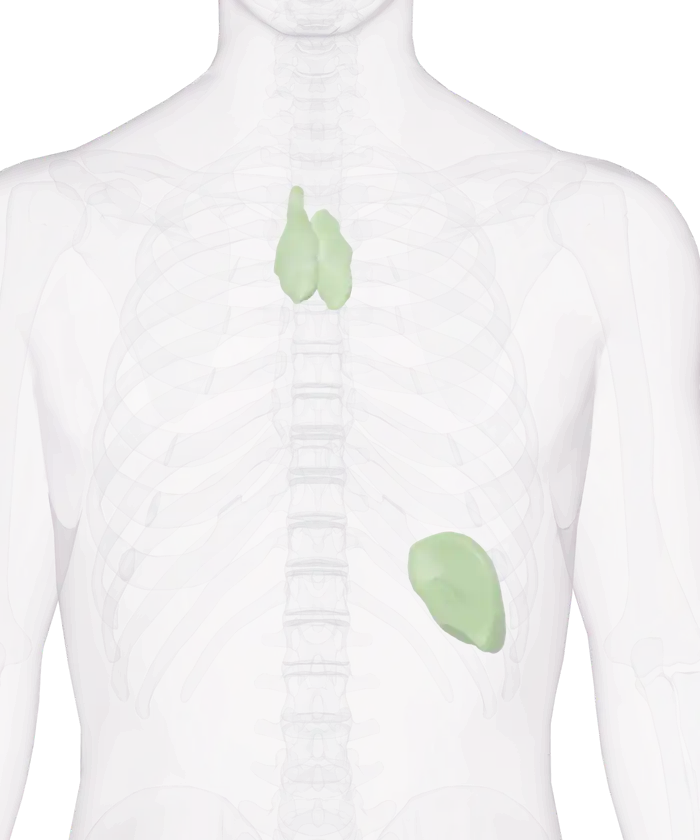
The spleen and thymus of the 3D anatomy model inside a glass rib cage, seen from the front

Pick a part

Tap or click the spleen or a lobe of the thymus for its name, a short description and its size. Turn the body to see the spleen behind the lowest left ribs.

Lymphatic and immune system: 3 parts

Switch a group on or off, or open its list to pick a part by name.

  • Groups in the lymphatic and immune system
See the full human anatomy

The model has the spleen and the thymus of one adult man, from the BodyParts3D project. It has no lymph nodes, no lymph vessels and no tonsils.

The lymphatic system of the model has 3 parts: the spleen and the left and right lobes of the thymus. The spleen measures 9.5 cm from front to back. The model has no lymph nodes, no lymph vessels and no tonsils, so most of what this system does is told in words.

The 3 parts of the model

The model has 3 lymphatic parts: the spleen and the 2 lobes of the thymus.
Part Where it sits Size in the model
Spleen Upper left abdomen, behind the lowest ribs 9.5 cm from front to back
Left lobe of thymus In the chest, behind the breastbone 5.9 cm tall
Right lobe of thymus In the chest, behind the breastbone 6.9 cm tall

The rib cage is drawn as glass. Turn the body to its left side to see the spleen behind the lowest ribs, and to the front to see the thymus behind the breastbone.

What the lymphatic system does

The lymphatic system has 3 jobs, according to the National Cancer Institute: to return tissue fluid to the blood, to absorb fats and fat-soluble vitamins from the gut, and to defend the body against microorganisms.

The lymphatic system has 4 kinds of organ, and the model draws 2 of them.
Organ What the source says In the model
Lymph nodes Bean-shaped, usually less than 2.5 cm long, along the lymph vessels No
Tonsils 3 groups of lymphatic tissue in the nose, mouth and throat No
Spleen The largest lymphatic organ, in the upper left abdomen Yes
Thymus A soft organ with 2 lobes, behind the breastbone Yes, as 2 lobes

About 90 percent of the fluid that leaves the smallest blood vessels returns to them. The rest becomes tissue fluid, and the lymph vessels carry it back to the blood. Fluid inside a lymph vessel is called lymph.

The spleen has 2 kinds of tissue. The white pulp holds lymphocytes, and the red pulp holds blood. The thymus is where one kind of lymphocyte, the T-lymphocyte, matures.

What the model leaves out

The model has no lymph nodes, no lymph vessels and no tonsils. The spleen and the thymus are smooth outer shapes. They belong to one adult man, in whom the thymus is small.

The blood that the spleen filters travels in the vessels of the 3D cardiovascular system. The stomach in front of the spleen is in the 3D digestive system, and the thymus also counts among the glands of the 3D endocrine system.

The lymphatic organs in the model by name

2 lymphatic organs. A part that comes as a left and right pair is listed once.

Spleen and thymus (2)
  • Lobe of thymus
  • Spleen

The largest lymphatic organ in the body, the spleen lies in the upper left abdomen, just beneath the diaphragm and behind the stomach. Blood enters through the splenic artery and is filtered as it moves through the sinuses. The spleen also removes old and damaged red blood cells, produces lymphocytes and holds a reserve of blood.

Behind the breastbone (sternum) and in front of the ascending aorta lies the thymus, a soft organ with two lobes. T-lymphocytes (T cells) are processed and mature there before they enter the blood and travel to other lymphatic organs. Relatively large in infants and children, the thymus begins to shrink after puberty and is quite small in older adults.

More to explore

Questions people ask

What does the spleen do?

The spleen filters blood. It clears old and damaged red blood cells, makes lymphocytes and stores blood that it can release in an emergency. The National Cancer Institute calls the spleen the largest lymphatic organ in the body.

Where is the thymus?

The thymus sits in the chest, behind the breastbone and in front of the first part of the aorta. It has 2 lobes. The National Cancer Institute notes that the thymus is relatively large in infants and children and shrinks after puberty.

How big is a lymph node?

A lymph node is usually less than 2.5 cm long, according to the National Cancer Institute, and is shaped like a bean. The model has no lymph nodes.

Where are the lymph nodes clustered?

Each side of the body has 3 clusters of lymph nodes near the surface: in the groin, in the armpit and in the neck. Lymph nodes lie along the paths of the lymph vessels and are absent from the brain and the spinal cord.

What are the tonsils?

The tonsils are clusters of lymphatic tissue under the lining of the nose, the mouth and the throat. There are 3 groups: the pharyngeal tonsils, the palatine tonsils and the lingual tonsils. The model has no tonsils.

6 sources
  1. Introduction to the Lymphatic System, SEER Training Modules, National Cancer Institute. Accessed 14 November 2026.
  2. Lymph Nodes, SEER Training Modules, National Cancer Institute. Accessed 14 November 2026.
  3. Tonsils, SEER Training Modules, National Cancer Institute. Accessed 14 November 2026.
  4. Spleen, SEER Training Modules, National Cancer Institute. Accessed 14 November 2026.
  5. Thymus, SEER Training Modules, National Cancer Institute. Accessed 14 November 2026.
  6. BodyParts3D, Database Center for Life Science (DBCLS), Japan. Accessed 14 November 2026.