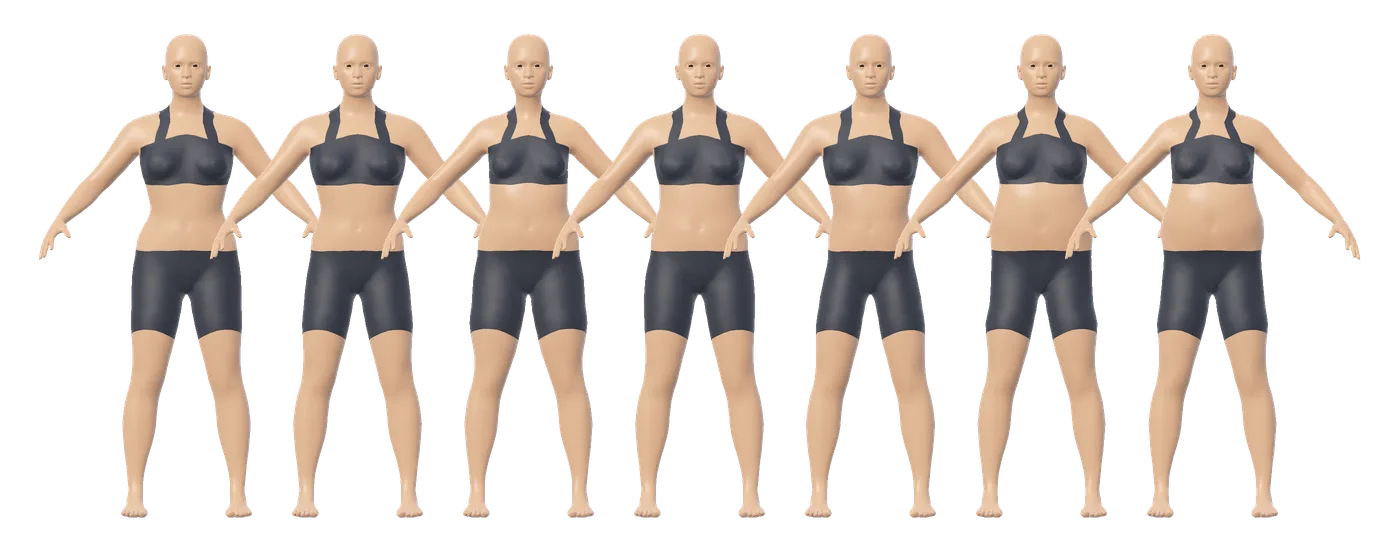
Seven female figures stand in one row, every one of them 165 cm tall and 62 kg: hourglass, top hourglass, pear, rectangle, inverted triangle, apple and diamond. Switch to male and five take their place at 178 cm and 78 kg: rectangle, trapezoid, inverted triangle, triangle and oval. Change the height or the weight and the whole row is redrawn at the new numbers. The only thing that differs from figure to figure is where the weight sits. Pick one shape to see it alone, with its bust or chest, waist and hip tapes drawn on.
Seven shapes at 62 kg, then at 75 kg: a worked example
At 165 cm (5 ft 5 in) and 62 kg (137 lb) the waist runs from 70.2 cm on the hourglass to 96.0 cm on the diamond. That is a spread of 25.8 cm (10.2 in) between figures of one weight. The pear measures 85.3, 81.5 and 98.0 cm at bust, waist and hips. The apple measures 95.6, 93.0 and 89.2 cm.
Now type 75 into the weight box (165 lb). All seven figures grow together.
| Shape | Bust | Waist | Hips | Waist to hip | Class by the rules |
|---|---|---|---|---|---|
| Hourglass | 107.4 cm (42.3 in) | 80.7 cm (31.8 in) | 108.6 cm (42.8 in) | 0.74 | Hourglass |
| Top hourglass | 109.7 cm (43.2 in) | 83.0 cm (32.7 in) | 102.1 cm (40.2 in) | 0.81 | Top hourglass |
| Pear | 96.0 cm (37.8 in) | 92.2 cm (36.3 in) | 108.7 cm (42.8 in) | 0.85 | Triangle |
| Rectangle | 103.4 cm (40.7 in) | 90.7 cm (35.7 in) | 106.0 cm (41.7 in) | 0.86 | Rectangle |
| Inverted triangle | 108.4 cm (42.7 in) | 88.0 cm (34.7 in) | 95.7 cm (37.7 in) | 0.92 | Inverted triangle |
| Apple | 106.3 cm (41.8 in) | 103.7 cm (40.8 in) | 99.9 cm (39.3 in) | 1.04 | Oval |
| Diamond | 99.1 cm (39.0 in) | 106.8 cm (42.0 in) | 101.7 cm (40.0 in) | 1.05 | Diamond |
Thirteen kilograms heavier, each bust, waist and hip number is 10 to 11 cm larger. The gaps between them have not moved. The hourglass waist is 11 in (27.9 cm) smaller than its hips at both weights, and its bust 0.5 in (1.3 cm) smaller. The class in the last column is the same at 62 kg as at 75 kg for all seven.
Press "Hourglass" in the picker and the row gives way to one figure with three tape lines. Its readout gives 107.4, 80.7 and 108.6, says how far the waist and bust sit from the hips, and names the class those numbers fall in. "All shapes" brings the row back.
How one weight is carried seven ways
Each shape starts from a sculpted whole-body form in the model, so more than three tape numbers change: the shoulders and ribcage follow the form too. The tool then sets the bust or chest and the waist at fixed gaps from the hips. Last, it searches for the hip girth at which the shaped body weighs what was typed. That search is why every figure in a row has the same weight.
Height scales each figure, and weight becomes volume through a body density worked out from BMI. Those two steps are shared with the 3D body visualizer, where the method is set out in full. Bust or chest, waist and hips are taken on each figure as level cuts, the way a tape would go round, with the arms left out.
What defines each female shape, in inches and centimeters
The female shapes are tied to measurement rules published for clothing research. Five of the rules in the table date from a 2007 study by Lee, Istook, Nam and Park, who put shape descriptions into formulas. In 2020 Sokolowski and Bettencourt reprinted those formulas and added the oval and diamond rules for bodies whose waist is larger than the hips. The rules are differences between bust, waist and hips in inches. The last column gives the gaps the tool draws, which sit inside each rule.
| Shape (class in the rules) | Rule in inches | Same rule in centimeters | What the tool draws |
|---|---|---|---|
| Hourglass | Bust minus hips 1 or less. Hips minus bust under 3.6. Bust minus waist 9 or more, or hips minus waist 10 or more. | Bust minus hips 2.5 or less. Hips minus bust under 9.1. Bust minus waist 22.9 or more, or hips minus waist 25.4 or more. | Bust 0.5 in smaller than the hips, waist 11 in smaller |
| Top hourglass | Bust minus hips over 1 and under 10. Bust minus waist 9 or more. | Bust minus hips over 2.5 and under 25.4. Bust minus waist 22.9 or more. | Bust 3 in larger than the hips, waist 7.5 in smaller |
| Pear (triangle) | Hips minus bust 3.6 or more. Hips minus waist under 9. | Hips minus bust 9.1 or more. Hips minus waist under 22.9. | Bust 5 in smaller than the hips, waist 6.5 in smaller |
| Rectangle | Bust and hips less than 3.6 apart. Bust minus waist under 9 and hips minus waist under 10. | Bust and hips less than 9.1 apart. Bust minus waist under 22.9 and hips minus waist under 25.4. | Bust 1 in smaller than the hips, waist 6 in smaller |
| Inverted triangle | Bust minus hips 3.6 or more. Bust minus waist under 9. | Bust minus hips 9.1 or more. Bust minus waist under 22.9. | Bust 5 in larger than the hips, waist 3 in smaller |
| Apple (oval) | Waist larger than the hips. Bust equal to the waist or larger. | The same in any unit. | Bust 2.5 in larger than the hips, waist 1.5 in larger |
| Diamond | Waist larger than the hips and larger than the bust. | The same in any unit. | Bust 1 in smaller than the hips, waist 2 in larger |
The centimeter figures are the inch cut-offs multiplied by 2.54 and rounded to one decimal place. Pear and apple are everyday names, and the rules call those classes triangle and oval.
Two classes in the published set are not drawn: bottom hourglass and spoon. Both depend on the high hip, a fourth measurement. The body shape calculator tests for them from your own numbers. Each shape is described one by one in the guide to body shape types.
Five male shapes, described in words and drawn in numbers
Rectangle, trapezoid, inverted triangle, triangle and oval are everyday names for men's builds. No published measurement standard sets cut-offs for them. The table gives the description the tool works from, with the chest, waist and hips it draws at 178 cm (5 ft 10 in) and 78 kg (172 lb).
| Shape | Everyday description (no published standard) | Chest, waist, hips at 178 cm and 78 kg |
|---|---|---|
| Rectangle | Chest, waist and hips close to one another | 99.2, 91.5, 97.9 cm (39.0, 36.0, 38.5 in) |
| Trapezoid | Chest larger than the hips, tapering to a clearly smaller waist | 104.0, 83.6, 96.3 cm (40.9, 32.9, 37.9 in) |
| Inverted triangle | Broad shoulders and chest over a narrower waist and hips | 106.1, 82.0, 92.1 cm (41.8, 32.3, 36.3 in) |
| Triangle | Waist and hips larger than the chest | 91.1, 96.2, 97.5 cm (35.9, 37.9, 38.4 in) |
| Oval | Waist the largest of the three | 96.5, 100.3, 93.9 cm (38.0, 39.5, 37.0 in) |
The gaps between the three numbers are the tool's own settings. The trapezoid chest is 3 in larger than its hips and its waist 5 in smaller. On the oval, the waist is 2.5 in larger than the hips. Because no rule exists to test them against, the male figures get no class name.
Where a row of model figures stops
The row answers one question: how different can bodies of one height and weight be? It does not name your own shape. For that, compare your tape numbers with the table, or give a woman's four measurements to the calculator.
Each figure is a model drawn from numbers, in a plain fitted base layer. A person whose measurements match a row can still carry the weight differently in the shoulders, back or legs.
The shape names describe proportions. The women's rules were built to sort body scans for garment fit, and no health finding sits behind any cut-off. The table does give each figure's waist to hip ratio. In the World Health Organization's report on waist measures, the cut-off points are 0.85 for women and 0.90 for men. For a ratio from your own tape, there is the waist to hip ratio calculator. Questions about your own health belong with a doctor or nurse.
Turning the row, zooming in and looking at one shape
Drag or swipe to turn every figure in the row at once, in any direction. Three buttons, Front, Side and Back, jump to those views, and Side shows every waist in profile. Pinch, use Ctrl with the scroll wheel, or press plus and minus to zoom. Two fingers, or Shift with a drag, slide the view along the row. On a narrow screen the figures stand in two rows.
The round control at the side turns the view when you drag it and starts or stops a slow spin when you press it. A double tap, or the home button, returns to the front. From the keyboard, the arrow keys do the turning. Full screen is offered where the browser allows it.
The Female and Male buttons change the set of shapes, and each set starts at its own height and weight. Three unit systems are offered: centimeters and kilograms, feet, inches and pounds, or stone and pounds. "Save image" downloads the view, and "Copy a link to this view" makes a link that holds the height, weight and chosen shape. To set every tape measurement on one shape, pick that shape in the female body visualizer or its male counterpart.