Skip to the main content
3D Body Visualizer

3D skin model: the largest organ of the body

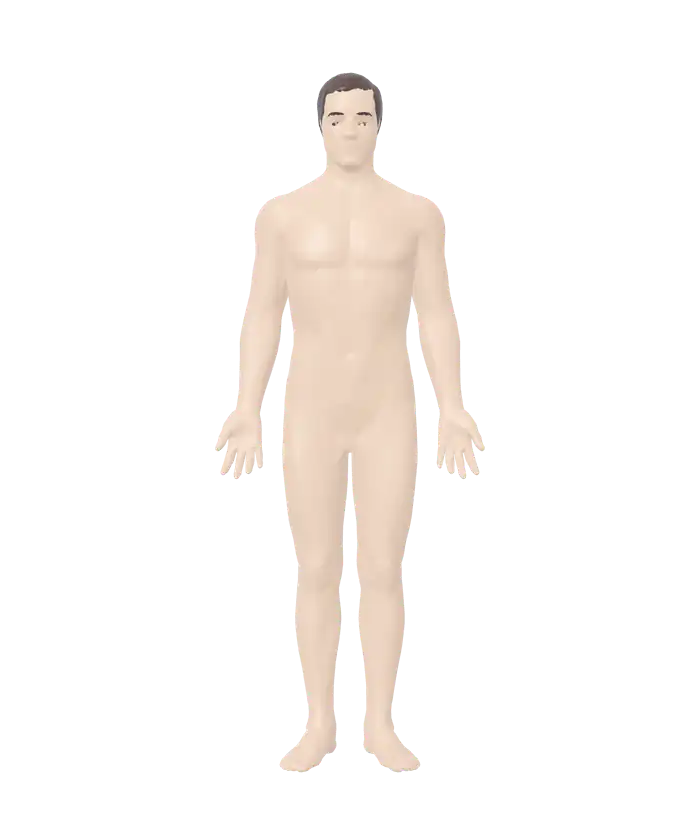
The skin and hair of the 3D anatomy model, seen from the front

Pick a part

Tap or click the skin, the hair or the eyebrows for the name and the size. The skin is one surface around the whole body.

Skin and hair: 3 parts

Switch a group on or off, or open its list to pick a part by name.

  • Groups in the skin and hair
See the full human anatomy

The skin is one outer surface of an adult man, from the BodyParts3D project. It has no layers, no nails and no glands.

The skin of the model is one surface 171.9 cm tall, with the hair of the head and the eyebrows as 2 separate parts. The group has 3 parts in all. The model draws the outside of the skin and none of the layers under it.

The 3 parts of the model

The skin of the model is one part, and the hair of the head and the eyebrows are 2 more.
Part What it is Size in the model
Skin One surface around the whole body 171.9 cm tall
Hair of head The hair as one solid shape 20.5 cm tall
Eyebrows Both eyebrows as one part 11.3 cm across both

The skin hides everything else, which makes this view the outside of the body. To see what the skin covers, open the full 3D anatomy, where every system can be switched on and the skin drawn around them as an outline.

The 3 layers of the skin

The skin is the largest organ of the body and has 3 layers, according to the National Cancer Institute.

The dermis, at 1.5 to 4 mm, is the thickest of the 3 layers of the skin.
Layer Thickness What it holds
Epidermis 0.05 mm on the eyelids, about 1.5 mm on the palms and soles The cells that make skin pigment, and sensory nerves
Dermis 1.5 to 4 mm Blood vessels, hair follicles, sweat glands, oil glands and nerve endings
Subcutis Differs from place to place Fat and collagen cells that insulate the body and absorb shock

The outermost sheet of the epidermis is 10 to 30 layers of dead cells. The cells of the epidermis are fully replaced every 28 to 30 days in young adults. The dermis makes up about 90 percent of the thickness of the skin.

The skin protects the body from heat, light, injury and infection. It helps control body temperature, gathers information through touch, and stores water and fat.

What the model leaves out

The model has no layers of the skin, no nails, no glands and no body hair apart from the head and the eyebrows. The skin is that of one adult man.

The eyelids and the outer ears, which the skin covers, are in the 3D eye and ear view. The muscles under the skin are in the 3D muscular system. To change the outline of a whole body by its numbers, use the 3D body visualizer.

The skin and hair in the model by name

3 parts. A part that comes as a left and right pair is listed once.

Skin (1)
  • Skin
Hair (2)
  • Eyebrows
  • Hair of head

Skin covers the entire outside of the body and is its largest organ, about 2 mm thick. It shields the body from heat, light and injury, helps regulate body temperature, and gathers sensory information from the surroundings. The outer layer is the epidermis and the second layer is the dermis, and both rest on a fatty layer called the subcutis or hypodermis.

Two arched ridges of thickened skin, the eyebrows (supercilia) run along the upper rim of the eye sockets (orbits). They carry many short, thick hairs that lie at a slant on the surface. Under the skin, each eyebrow is connected with three muscles: the orbicularis oculi, the corrugator and the frontalis.

Hairs grow on nearly every part of the body surface, and those of the scalp reach considerable length. Each hair has a root set in the skin and a shaft that projects from the surface. The root ends in a hair bulb lodged in a pit of the epidermis, the hair follicle, into which oil (sebaceous) glands open.

More to explore

Questions people ask

What are the three layers of the skin?

The three layers of the skin are the epidermis on the outside, the dermis under it and the subcutis, also called the hypodermis, at the bottom. The model draws the skin as one surface and shows none of the layers.

How thick is the skin?

The thickness of the skin differs by place. The National Cancer Institute gives 0.05 mm for the epidermis of the eyelids and about 1.5 mm for the palms and the soles. The dermis under it is 1.5 to 4 mm thick.

How often does the skin renew itself?

The cells of the epidermis are fully replaced every 28 to 30 days in young adults, according to the National Cancer Institute, and every 45 to 50 days in elderly adults.

Is the skin an organ?

Yes. The skin is the largest organ of the body. It protects the body from heat, light, injury and infection, helps control body temperature and gathers information through touch.

What is in the dermis?

The dermis holds blood vessels, lymph vessels, hair follicles, sweat glands, oil glands and nerve endings, held together by collagen and elastin. The dermis is the thickest of the 3 layers of the skin.

4 sources
  1. Anatomy of the Skin, SEER Training Modules, National Cancer Institute. Accessed 14 November 2026.
  2. Layers of the Skin, SEER Training Modules, National Cancer Institute. Accessed 14 November 2026.
  3. Health Lesson: Learning About Skin, National Institute of Arthritis and Musculoskeletal and Skin Diseases. Accessed 14 November 2026.
  4. BodyParts3D, Database Center for Life Science (DBCLS), Japan. Accessed 14 November 2026.