Skip to the main content
3D Body Visualizer

Digestive system 3D model: 53 parts from the tongue to the rectum

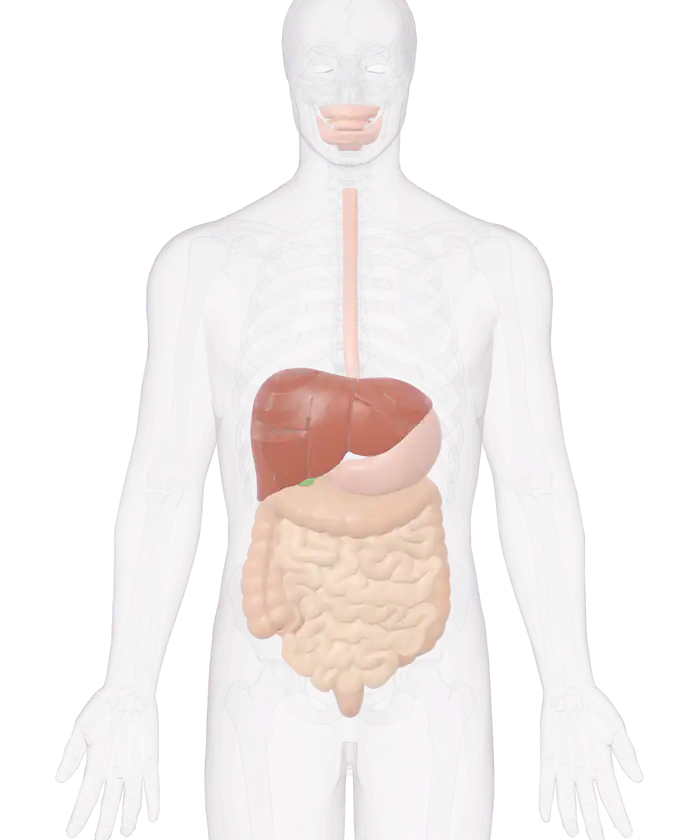
The digestive organs of the 3D anatomy model inside a glass skeleton, seen from the front

Pick a part

Tap or click an organ of the digestive tract for its name, a short description and its size. Hide the liver or the small intestine to see what lies behind.

Digestive system: 53 parts

Switch a group on or off, or open its list to pick a part by name.

  • Groups in the digestive system
See the full human anatomy

The digestive organs are those of one adult man, from the BodyParts3D project. The model has no separate cecum or sigmoid colon, and organs differ in size and place from person to person.

The digestive system of the model has 53 parts in 6 groups. Its esophagus is 27.4 cm long, and its stomach is 13.4 cm from side to side. Tap any organ for its name, then hide it to see what lies behind.

The digestive system of the model in 6 groups

The liver and bile ducts make up 22 of the 53 digestive parts of the model.
Group Parts What it holds
Mouth and throat 8 The tongue, the lips, the gums and 2 pairs of salivary glands
Esophagus and stomach 2 The esophagus and the stomach
Small intestine 8 The duodenum, the jejunum and the ileum, with the mesentery
Large intestine 11 The appendix, the colon, the rectum and the 3 bands of the colon
Liver and bile ducts 22 The liver in 8 segments, the gallbladder and the bile ducts
Pancreas 2 The pancreas and its ducts

The teeth are listed with the skeleton. The skeleton is drawn as glass, so the organs show where they sit against the ribs, the spine and the pelvis.

From the mouth to the rectum

The digestive tract is one continuous tube about 9 meters long, according to the National Cancer Institute.

The digestive tract is one tube about 9 meters long, in 6 regions.
Region What the source says In the model
Mouth A full set of permanent teeth is 32 Tongue, lips, gums and salivary glands
Esophagus A collapsible tube behind the trachea One part, 27.4 cm long
Stomach 4 regions: fundic, cardiac, body and pyloric One part, 13.4 cm wide
Small intestine 3 parts: duodenum, jejunum and ileum Duodenum, and the jejunum and the ileum in 3 parts each
Large intestine Colon, rectum and anal canal Ascending, transverse and descending colon, rectum and appendix

The wall of the tract has 4 layers: the mucosa, the submucosa, the muscular layer and the serosa. Three bands of muscle run the length of the colon and gather it into pouches. The model draws the 3 bands as separate parts.

The liver, the gallbladder and the pancreas

The liver is the largest gland in the body and lies under the diaphragm. The gallbladder is a pear-shaped sac that stores bile. The pancreas makes digestive enzymes, and its islets make the hormones insulin and glucagon.

In the model the liver comes in 8 segments, and the gallbladder and the bile ducts are drawn green. Tap the liver and press Hide it, and the stomach, the gallbladder and the right kidney behind it come into view.

What the model leaves out

The model has no separate cecum or sigmoid colon, no anal canal and no parotid glands. The organs are smooth outer shapes without their inner layers. They belong to one adult man, and the size and place of the organs differ from person to person.

The organs of the body view finds organs by side and by level. The kidneys behind the intestines are in the 3D urinary system, and the guide on where the liver is covers that organ alone.

Every digestive organ in the model by name

50 digestive parts. A part that comes as a left and right pair is listed once.

Mouth and throat (6)
  • Gingiva of lower jaw
  • Gingiva of upper jaw
  • Lips
  • Sublingual gland
  • Submandibular gland
  • Tongue
Esophagus and stomach (2)
  • Esophagus
  • Stomach
Small intestine (8)
  • Distal part of ileum
  • Distal part of jejunum
  • Duodenum
  • Mesentery of small intestine
  • Middle part of ileum
  • Middle part of jejunum
  • Proximal part of ileum
  • Proximal part of jejunum
Large intestine (11)
  • Appendix
  • Ascending colon
  • Descending colon
  • Ileocecal junction
  • Mesoappendix
  • Rectum
  • Taenia libera
  • Taenia mesocolica
  • Taenia omentalis
  • Transverse colon
  • Transverse mesocolon
Liver and bile ducts (21)
  • Anterior inferior tributary of hepatic biliary tree
  • Anterior superior tributary of hepatic biliary tree
  • Caudate lobe of liver
  • Common hepatic duct
  • Cystic duct
  • Duct of caudate lobe of liver
  • Gallbladder
  • Hepatic duct
  • Lateral inferior tributary of hepatic biliary tree
  • Lateral superior tributary of hepatic biliary tree
  • Liver segment II
  • Liver segment III
  • Liver segment IV
  • Liver segment V
  • Liver segment VI
  • Liver segment VII
  • Liver segment VIII
  • Medial inferior tributary of hepatic biliary tree
  • Medial superior tributary of hepatic biliary tree
  • Posterior inferior tributary of hepatic biliary tree
  • Posterior superior tributary of hepatic biliary tree
Pancreas (2)
  • Pancreas
  • Pancreatic ducts

More to explore

Questions people ask

How long is the digestive tract?

The digestive tract is about 9 meters long, according to the National Cancer Institute. It is one continuous tube from the mouth to the anus: mouth, pharynx, esophagus, stomach, small intestine and large intestine.

What are the three parts of the small intestine?

The three parts of the small intestine are the duodenum, the jejunum and the ileum. The small intestine runs from the pyloric sphincter of the stomach to the ileocecal valve. The model draws the jejunum and the ileum in 3 parts each.

What does the large intestine do?

The large intestine absorbs water and electrolytes, and the National Cancer Institute notes that it makes no digestive enzymes. It runs from the ileocecal junction to the anus and consists of the colon, the rectum and the anal canal.

What is the largest gland in the body?

The liver is the largest gland in the body, according to the National Cancer Institute. It lies under the diaphragm. The liver of the model is 20.9 cm from side to side and is drawn in 8 segments.

Which organs help digestion without being part of the tract?

The salivary glands, the liver, the gallbladder and the pancreas help digestion from outside the tract. There are 3 pairs of major salivary glands. The gallbladder stores bile, and the pancreas makes digestive enzymes and the hormones insulin and glucagon.

6 sources
  1. Introduction to the Digestive System, SEER Training Modules, National Cancer Institute. Accessed 14 November 2026.
  2. General Structure of the Digestive System, SEER Training Modules, National Cancer Institute. Accessed 14 November 2026.
  3. Stomach, SEER Training Modules, National Cancer Institute. Accessed 14 November 2026.
  4. Small & Large Intestine, SEER Training Modules, National Cancer Institute. Accessed 14 November 2026.
  5. Accessory Organs, SEER Training Modules, National Cancer Institute. Accessed 14 November 2026.
  6. BodyParts3D, Database Center for Life Science (DBCLS), Japan. Accessed 14 November 2026.