Skip to the main content
3D Body Visualizer

Urinary system 3D model: kidneys, ureters, bladder and urethra

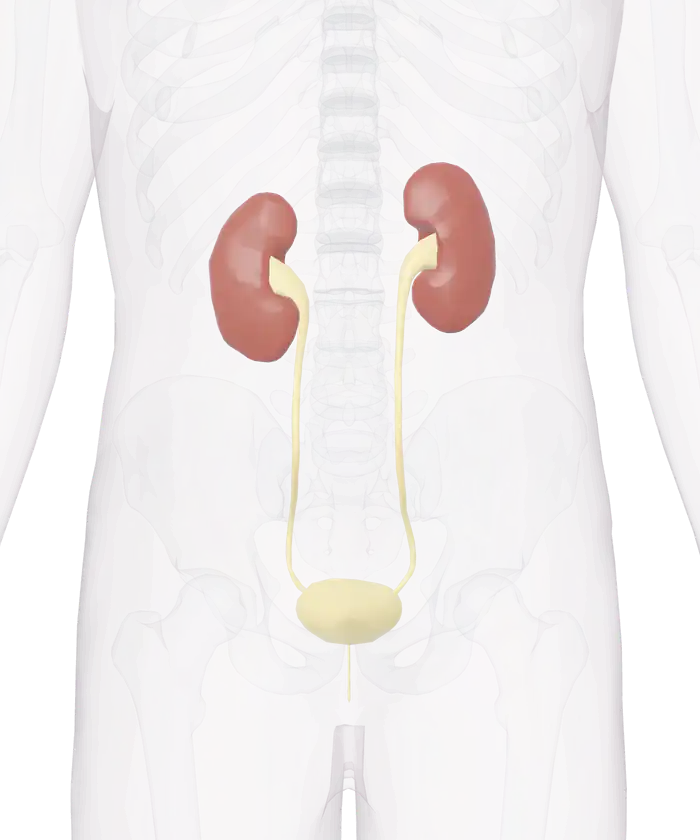
The kidneys, ureters and bladder of the 3D anatomy model inside a glass skeleton, seen from the front

Pick a part

Tap or click a kidney, a ureter, the bladder or the urethra for its name, a short description and its size. Turn the body to the back to see the kidneys against the lowest ribs.

Urinary system: 6 parts

Switch a group on or off, or open its list to pick a part by name.

  • Groups in the urinary system
See the full human anatomy

The urinary organs are those of one adult man, from the BodyParts3D project. The kidneys are smooth outer shapes without their inner parts.

The urinary system of the model has 6 parts: 2 kidneys, 2 ureters, the urinary bladder and the urethra. Its ureters measure 25.4 cm and 24.6 cm from top to bottom, close to the 25 cm the National Cancer Institute gives for an adult. Turn the body to the back to see the kidneys against the lowest ribs.

The 6 parts of the urinary system

The urinary system of the model is complete in 6 parts.
Part How many Size in the model
Kidney 2 10.6 cm tall on the left, 10.4 cm on the right
Ureter 2 25.4 cm on the left, 24.6 cm on the right
Urinary bladder 1 6.7 cm from side to side
Urethra 1 A short part under the bladder

The right kidney of the model lies about 2 cm lower than the left. The skeleton is drawn as glass, so each kidney shows against the spine and the lowest ribs.

What each part does

The urinary system keeps the volume and the makeup of the body's fluids in a normal range and removes waste, according to the National Cancer Institute.

An adult kidney is about 12 cm long, and each ureter is about 25 cm long.
Part What the source says
Kidneys About 12 cm long, 6 cm wide and 3 cm thick, with over a million nephrons each
Ureters About 25 cm long, with a muscle layer that moves urine to the bladder
Urinary bladder A temporary storage reservoir for urine, behind the pubic bone
Urethra 3 to 4 cm long in women and about 20 cm in men

The kidneys do more than make urine. They release a hormone that prompts the making of red blood cells, and an enzyme, renin, that takes part in the control of blood pressure.

The 2 ureters and the urethra open into the floor of the bladder at 3 points, which mark out a triangle called the trigone. Tap the bladder in the model, press Fade the rest, and both ureters can be followed down to it.

What the model leaves out

The kidneys are smooth outer shapes, so the cortex, the medulla and the renal pelvis inside them are not drawn. The urethra is a short part and not its full length. The organs are those of one adult man.

The adrenal glands on top of the kidneys are in the 3D endocrine system. The male organs that share the urethra are in the 3D reproductive system, and the organs of the body view shows the kidneys behind the intestines.

The urinary organs in the model by name

4 urinary organs. A part that comes as a left and right pair is listed once.

Kidneys (1)
  • Kidney
Ureters, bladder and urethra (3)
  • Ureter
  • Urethra
  • Urinary bladder

A small tube about 25 cm long, each ureter carries urine from the renal pelvis of a kidney to the urinary bladder. It runs down the back wall of the abdomen, behind the peritoneum, and enters the bladder on its lower back surface. Smooth muscle in its wall pushes the urine along by peristalsis.

The kidneys filter the blood, remove wastes and pass those wastes out in the urine. One lies on each side of the spine, against the back wall of the abdomen, protected by the lower ribs. Each adult kidney is roughly bean-shaped, about 12 cm long, 6 cm wide and 3 cm thick, with over a million working units called nephrons.

The final passageway for urine is the urethra, a thin-walled tube from the floor of the urinary bladder to the outside. In males the tube is about 20 cm long and carries both urine and semen, passing through the prostate, the pelvic floor and the penis. Two sphincters, one involuntary and one voluntary, control the flow of urine.

Urine is stored for a time in the urinary bladder, which lies in the pelvic cavity behind the pubic symphysis. Its size and shape change with the amount of urine it holds, and folds in its lining let the wall expand as it fills. Smooth muscle in the wall, the detrusor muscle, contracts to expel the urine.

More to explore

Questions people ask

Where are the kidneys?

The kidneys sit at the back of the abdomen, one on each side of the spine, between the twelfth thoracic and the third lumbar vertebra. The National Cancer Institute adds that the right kidney is usually a little lower than the left, since the liver pushes it down.

How big is a kidney?

An adult kidney is about 12 cm long, 6 cm wide and 3 cm thick, according to the National Cancer Institute. The kidneys of the model are 10.6 cm and 10.4 cm from top to bottom.

How long is a ureter?

Each ureter is about 25 cm long and carries urine from the kidney to the bladder. The ureters of the model measure 25.4 cm on the left and 24.6 cm on the right.

How many nephrons does a kidney have?

Each kidney has over a million nephrons, according to the National Cancer Institute. A nephron is the working unit of the kidney. The model draws each kidney as a smooth outer shape and shows no nephrons.

How long is the urethra?

The female urethra is 3 to 4 cm long and the male urethra about 20 cm, according to the National Cancer Institute. The male urethra also carries semen. The model draws a short part of the male urethra under the bladder.

6 sources
  1. Introduction to the Urinary System, SEER Training Modules, National Cancer Institute. Accessed 14 November 2026.
  2. Kidneys, SEER Training Modules, National Cancer Institute. Accessed 14 November 2026.
  3. Ureters, SEER Training Modules, National Cancer Institute. Accessed 14 November 2026.
  4. Urinary Bladder, SEER Training Modules, National Cancer Institute. Accessed 14 November 2026.
  5. Urethra, SEER Training Modules, National Cancer Institute. Accessed 14 November 2026.
  6. BodyParts3D, Database Center for Life Science (DBCLS), Japan. Accessed 14 November 2026.