Skip to the main content
3D Body Visualizer

Endocrine system 3D model: the pituitary, pineal and adrenal glands

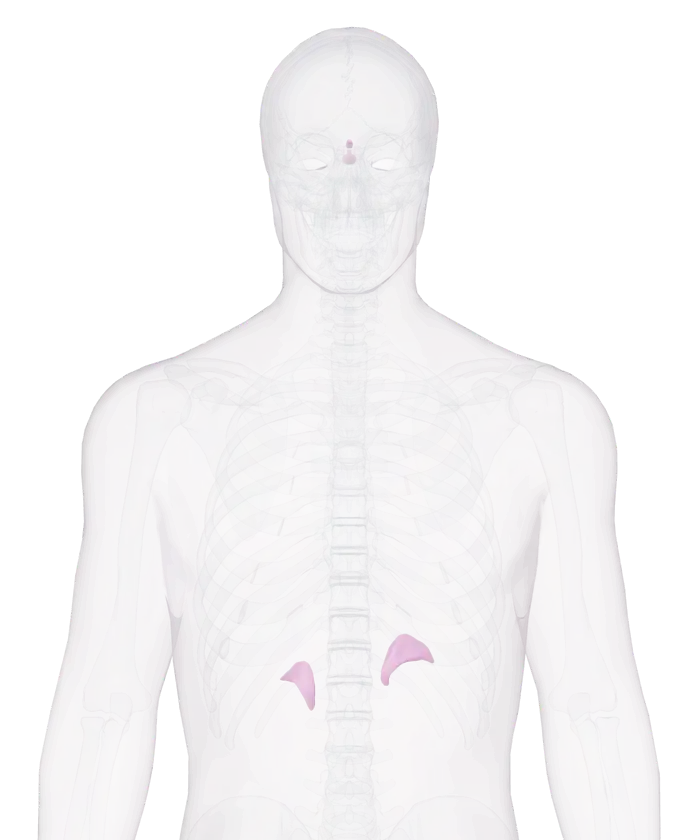
The pituitary gland, pineal body and adrenal glands of the 3D anatomy model inside a glass skeleton, seen from the front

Pick a part

Tap or click a gland for its name, a short description and its size. The pituitary gland and the pineal body sit deep in the head, so zoom in or pull them out.

Endocrine system: 4 parts

Switch a group on or off, or open its list to pick a part by name.

  • Groups in the endocrine system
See the full human anatomy

The model has 4 endocrine glands of one adult man, from the BodyParts3D project. The thyroid and parathyroid glands are missing, and the pancreas and the testes are listed with other systems.

The endocrine system of the model has 4 glands: the pituitary gland, the pineal body and the 2 adrenal glands. The pituitary gland is 1.2 cm across in this body, and the National Cancer Institute gives about 1 cm for an adult. The glands sit far apart, so the skeleton is drawn as glass to show where each one lies.

The 4 glands of the model

The model has 4 endocrine glands: 2 in the head and 2 on the kidneys.
Gland Where it sits Size in the model
Pituitary gland At the base of the brain, in a hollow of the sphenoid bone 1.2 cm from side to side
Pineal body Deep in the brain, by the third ventricle 1.1 cm from front to back
Left adrenal gland On top of the left kidney 4.8 cm from side to side
Right adrenal gland On top of the right kidney 3.2 cm from side to side

The 2 glands of the head are small and deep. Type pituitary into the search box, pick the gland and press Zoom to it, or press Pull it out to slide it clear of the skull.

The glands and their hormones

Endocrine glands have no ducts and release hormones straight into the blood, according to the National Cancer Institute, which counts 8 major endocrine glands.

Of the glands the source covers, the model draws the pituitary, the pineal and the adrenals in this system.
Gland A hormone it makes In the model
Pituitary Growth hormone Yes
Pineal Melatonin Yes, as the pineal body
Thyroid Thyroxine No
Parathyroids Parathyroid hormone No
Adrenals Cortisol and epinephrine Yes
Pancreas, in its islets Insulin and glucagon With the digestive system
Testes Testosterone With the reproductive system
Thymus Thymosin With the lymphatic system

A hormone acts only on cells that carry a matching receptor. Hormone effects last minutes, hours or weeks, where the effects of a nerve impulse last seconds.

The pituitary gland makes hormones that drive other glands. One prompts the thyroid and another the outer layer of the adrenal glands. The adrenal cortex is essential to life, and the adrenal medulla makes epinephrine under stress.

What the model leaves out

The model has no thyroid gland and no parathyroid glands. The pancreas, the testes and the thymus make hormones too, and the model lists each with another system. The glands are those of one adult man.

The brain around the pituitary gland and the pineal body is in the 3D nervous system. The kidneys under the adrenal glands are in the 3D urinary system, and the thymus is in the 3D lymphatic system.

The endocrine glands in the model by name

3 glands. A part that comes as a left and right pair is listed once.

Glands (3)
  • Adrenal gland
  • Pineal body
  • Pituitary gland

A small cone-shaped structure, the pineal body (pineal gland) extends backward from the third ventricle of the brain. Its secretory cells, the pinealocytes, make the hormone melatonin and release it into the cerebrospinal fluid, which carries it into the blood. Melatonin affects reproductive development and daily body cycles.

About the size of a pea, the pituitary gland rests in a hollow of the sphenoid bone called the sella turcica. A slender stalk connects it to the hypothalamus of the brain. The front lobe releases growth hormone and hormones acting on the thyroid, adrenal cortex and gonads, and the back lobe releases antidiuretic hormone and oxytocin.

One adrenal gland sits near the upper part of each kidney. Its outer cortex makes steroid hormones, including aldosterone, which conserves sodium and water, and cortisol, which raises blood glucose levels. Its inner medulla releases epinephrine and norepinephrine when sympathetic nerves stimulate it, particularly in stressful situations.

More to explore

Questions people ask

How many endocrine glands are there?

The National Cancer Institute counts 8 major endocrine glands. Its pages cover the pituitary, the pineal, the thyroid, the parathyroids, the adrenals, the islets of the pancreas and the gonads, and add the thymus among other organs that make hormones.

How big is the pituitary gland?

The pituitary gland is about 1 cm across, according to the National Cancer Institute. It sits in a hollow of the sphenoid bone at the base of the skull. The pituitary gland of the model is 1.2 cm from side to side.

Where are the adrenal glands?

There is one adrenal gland on top of each kidney. Each has an outer cortex and an inner medulla. The cortex makes aldosterone and cortisol, and the medulla makes epinephrine and norepinephrine.

What does the pineal gland make?

The pineal gland makes the hormone melatonin, which affects daily cycles. The National Cancer Institute describes it as a small cone-shaped gland by the third ventricle of the brain. The model lists it as the pineal body.

Why is the thyroid missing from the model?

The source data of the model has no thyroid gland and no parathyroid glands. The thyroid has 2 lobes, one on each side of the trachea just below the larynx, and 4 parathyroid glands sit on its back surface.

7 sources
  1. Introduction to the Endocrine System, SEER Training Modules, National Cancer Institute. Accessed 14 November 2026.
  2. Endocrine Glands & Their Hormones, SEER Training Modules, National Cancer Institute. Accessed 14 November 2026.
  3. Pituitary & Pineal Glands, SEER Training Modules, National Cancer Institute. Accessed 14 November 2026.
  4. Thyroid & Parathyroid Glands, SEER Training Modules, National Cancer Institute. Accessed 14 November 2026.
  5. Adrenal Gland, SEER Training Modules, National Cancer Institute. Accessed 14 November 2026.
  6. Other Endocrine Glands, SEER Training Modules, National Cancer Institute. Accessed 14 November 2026.
  7. BodyParts3D, Database Center for Life Science (DBCLS), Japan. Accessed 14 November 2026.