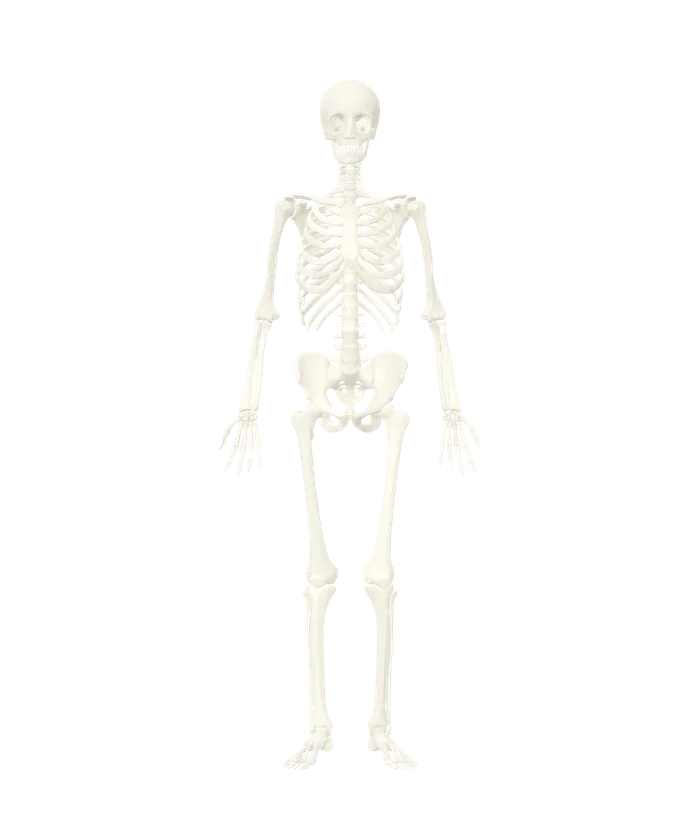
An adult skeleton usually has 206 named bones: 80 in the axial skeleton and 126 in the limbs and their girdles (National Cancer Institute, SEER training modules). The skeleton here shows 199 of them as separate parts. Each can be tapped for its name, lifted out and turned around.
Bones by region, in the adult body and in the model
| Region | Adult skeleton | In the model |
|---|---|---|
| Skull | 28, with 6 ear bones | 22, no ear bones |
| Hyoid | 1 | 1 |
| Vertebral column | 26 | 25: 24 vertebrae and the sacrum |
| Sternum and ribs | 25 | 24 ribs, sternum in 3 parts |
| Shoulder girdles, arms and hands | 64 | 64 |
| Hip bones, legs and feet | 62 | 62, plus 2 sesamoid bones |
The adult counts are those of the National Cancer Institute's lists. Each hand has 27 bones in both columns: 8 carpals in the wrist, 5 metacarpals in the palm and 14 phalanges in the fingers. Each foot has 26: 7 tarsals, 5 metatarsals and 14 phalanges.
Around the bones the skeletal system carries 78 more parts. There are 28 teeth, 23 disks between the vertebrae, 14 rib cartilages and 5 cartilages of the nose. Membranes join the two bones of each forearm and each lower leg, and two ligaments run at the hyoid and two under the feet.
The longest bones in the model
| Bone | Length | Common name |
|---|---|---|
| Femur | 46.6 cm | Thigh bone |
| Fibula | 38.4 cm | Outer bone of the lower leg |
| Tibia | 38.0 cm | Shin bone |
| Humerus | 30.7 cm | Upper arm bone |
| Ulna | 24.8 cm | Forearm bone on the little finger side |
| Radius | 22.9 cm | Forearm bone on the thumb side |
Each length is the height of the bone as it stands in this body, which is about 172 cm tall. Gray's Anatomy describes the femur as "the longest and strongest bone in the skeleton." At the other end of the scale, the middle bone of the little toe is under 1 cm long.
What a tap on a bone gives
Tap the collarbone on the body's left. The card reads Left clavicle, Skeletal system, Shoulder, arm and hand, Left side, with its size: about 14 cm across. The same card comes up from the search box. Typing scaph finds the left and right scaphoid, two of the sixteen wrist bones, and picking one flies the view to that wrist.
Every group has its own switch and its own list. Open Skeletal system and switch off everything but Skull and hyoid, and the 30 parts of the head stand alone: 22 skull bones, the hyoid, 5 nose cartilages and 2 ligaments. List the parts shows all 30 names, and each name selects its bone.
Taking the wrist apart
The wrist is the hardest part of the skeleton to read from a flat picture, since eight small bones sit in two rows. Tap any wrist bone, press Zoom to it, then move the pull-apart slider. The bones drift away from each other and each can be tapped for its name. Gray's Anatomy arranges them in two rows. With modern names in place of its older ones, the row nearer the forearm holds the scaphoid, lunate, triquetral and pisiform. The row nearer the palm holds the trapezium, trapezoid, capitate and hamate.
Press Pull it out on the scaphoid and it slides clear of the hand. A drag moves it, and a swipe on the background turns the view. Put it back returns it, and Reset clears everything.
Ten questions from 47 bones
Start the quiz and one bone lights up in a glass skeleton. Four names appear, taken from the same region where possible, so a wrist bone is offered against other wrist bones. The skeleton still turns during a question, which helps with bones that hide behind others, such as the sphenoid or the talus.
The quiz covers nine skull bones, the hyoid, the atlas and axis, the sacrum, the three parts of the sternum and the first and twelfth ribs. From the limbs it takes the collarbone, shoulder blade and hip bone, the six long bones and the kneecap. The eight wrist bones and the seven ankle and foot bones are all included. The first and fifth bones of the palm and of the foot complete the list. A quiz on the muscles works the same way.
What the skeleton leaves out
The six ear bones are absent, the coccyx is not a separate part, and there are no wisdom teeth. Only the first seven ribs have their cartilages. The membranes of the forearm and lower leg and one ligament under each foot are present. The limbs have no other ligaments, so the joints show as bare bone ends.
The bones are those of one adult man from the BodyParts3D project. Real skeletons differ in size and proportion, and how many bones the body has explains why counts differ between a baby and an adult. The same body with its organs and vessels is in the full 3D anatomy view.