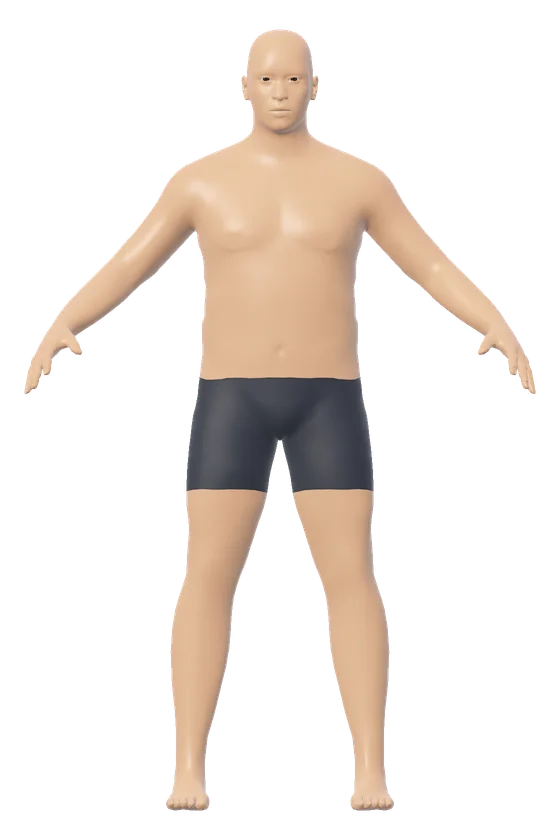
A man of 175.1 cm (68.9 in, just under 5 ft 9 in) and 90.3 kg (199.0 lb) is the first thing the male figure shows. Those are the CDC's mean height and weight for US men aged 20 and older, measured from August 2021 to August 2023. Type a different height or weight, set a chest, waist or shoulder width, or move the Build slider, and the figure is redrawn. Because it takes any height and weight, it doubles as a male body simulator for a size or build you want to look at.
One man, three builds: 90.3 kg from softer to athletic
At the typical build the model estimates a 108.0 cm chest, a 99.1 cm waist, 107.6 cm hips and a shoulder width of 37.7 cm. The BMI is 29.5, overweight in the CDC's categories. Waist to hip is 0.92, over the 0.90 cut-off for men, and waist to height is 0.57, increased central adiposity.
Now slide Build to the athletic end and leave the height and weight alone. The waist falls to 82.3 cm and the hips to 95.3 cm. The upper arm grows from 33.6 to 45.5 cm and the thigh from 58.1 to 65.2 cm. The chest hardly moves. Waist to hip drops to 0.86 and waist to height to 0.47. The BMI still reads 29.5, overweight, because it is worked out from height and weight alone.
| Build | Chest | Waist | Hips | Upper arm | Shoulder width |
|---|---|---|---|---|---|
| Softer end | 106.9 cm (42.1 in) | 102.3 cm (40.3 in) | 109.5 cm (43.1 in) | 32.3 cm (12.7 in) | 37.4 cm (14.7 in) |
| Typical | 108.0 cm (42.5 in) | 99.1 cm (39.0 in) | 107.6 cm (42.4 in) | 33.6 cm (13.2 in) | 37.7 cm (14.8 in) |
| Athletic end | 108.4 cm (42.7 in) | 82.3 cm (32.4 in) | 95.3 cm (37.5 in) | 45.5 cm (17.9 in) | 40.1 cm (15.8 in) |
Build is the model's own setting for how much of the weight is carried as muscle. It is not a tape measurement. The figure has no surface detail, so the slider changes bulk and proportion and draws no muscle definition.
How 175.1 cm and 90.3 kg become a male figure
The male base figure is scaled to the height entered. For the weight, the model takes a body density from the BMI, which is 1.040 kg per liter here. It sizes the figure to the 86.8 liters that weigh 90.3 kg at that density. Build moves that volume around the body and leaves the total alone.
Chest is measured as a level cut at the fullest point of the chest, arms left out. Shoulder width is a straight line between the two outer shoulder points, and no tape goes around the shoulders. Type 112 cm for the chest and 41 cm for shoulder width. The model holds both at 90.3 kg, and the waist settles at 97.2 cm and the hips at 106.3 cm. Rows you do not type stay as estimates. The 3D body visualizer gives the method step by step, with its formulas.
How 2,690 measured men spread around the average
In the survey behind the opening body, the CDC measured 2,690 men aged 20 and older for height and 2,688 for weight. Half of them weighed 86.6 kg (191.0 lb) or less, which is 3.7 kg under the mean.
| Percentile | Height | Weight | BMI | Waist |
|---|---|---|---|---|
| 5th | 162.2 cm (63.9 in) | 60.9 kg (134.2 lb) | 20.9 | 79.3 cm (31.2 in) |
| 10th | 165.2 cm (65.0 in) | 66.6 kg (146.8 lb) | 22.3 | 83.5 cm (32.9 in) |
| 25th | 170.0 cm (66.9 in) | 75.4 kg (166.3 lb) | 24.9 | 91.4 cm (36.0 in) |
| 50th (median) | 175.2 cm (69.0 in) | 86.6 kg (191.0 lb) | 28.2 | 100.9 cm (39.7 in) |
| 75th | 180.1 cm (70.9 in) | 100.6 kg (221.9 lb) | 32.6 | 112.3 cm (44.2 in) |
| 90th | 184.8 cm (72.7 in) | 118.8 kg (261.8 lb) | 37.8 | 124.3 cm (48.9 in) |
| 95th | 187.2 cm (73.7 in) | 131.8 kg (290.6 lb) | 42.1 | 133.2 cm (52.4 in) |
| Mean | 175.1 cm (68.9 in) | 90.3 kg (199.0 lb) | 29.4 | 103.0 cm (40.6 in) |
Put the median weight on the mean height and the tool reads a BMI of 28.2, with a 95.7 cm waist on the model. One man in four had a BMI of 24.9 or less, and the CDC's healthy weight category runs from 18.5 to less than 25.
For men the CDC's mean BMI is 29.4, and the opening figure reads 29.5. The two differ because the tool works the BMI out from the mean height and the mean weight, while the CDC averages each man's own BMI.
The mean waist of 103.0 cm (40.6 in) is taped at the top of the hip bone, so it is not a trouser size. The report gives waist in centimeters, and the inch figures are conversions at 2.54 cm per inch.
Five male shapes, with no measurement standard behind the names
The picker gives the male figure a typical build and five shapes: rectangle, trapezoid, inverted triangle, triangle and oval. Pick one and the height and weight stay while chest, waist, hips and shoulder width change.
| Shape | Chest | Waist | Hips | Shoulder width |
|---|---|---|---|---|
| Rectangle | 110.2 cm (43.4 in) | 102.6 cm (40.4 in) | 109.0 cm (42.9 in) | 37.5 cm (14.8 in) |
| Trapezoid | 115.2 cm (45.4 in) | 94.9 cm (37.4 in) | 107.6 cm (42.4 in) | 40.7 cm (16.0 in) |
| Inverted triangle | 117.4 cm (46.2 in) | 93.3 cm (36.7 in) | 103.5 cm (40.7 in) | 43.2 cm (17.0 in) |
| Triangle | 102.7 cm (40.4 in) | 107.7 cm (42.4 in) | 109.0 cm (42.9 in) | 32.9 cm (13.0 in) |
| Oval | 107.7 cm (42.4 in) | 111.5 cm (43.9 in) | 105.2 cm (41.4 in) | 35.6 cm (14.0 in) |
These are everyday names. No published measurement standard says where a rectangle ends and a trapezoid begins. The gaps between chest, waist and hips in each row are the tool's own settings. For the same reason the male figure gets no shape class in its results. The class shown for the female figure follows rules written from women's measurements for clothing research. The body shape visualizer draws the five side by side.
What a model of the average man leaves open
The opening figure was drawn from two numbers, and the model had to estimate the rest. Its waist of 99.1 cm, taken at the natural waist, is 3.9 cm less than the CDC's mean of 103.0 cm at the hip bone. Its hips of 107.6 cm are 2.0 cm more than the CDC's mean of 105.6 cm. Men of this height and weight differ from both, as the three builds show, so type your own chest, waist and hips where you know them.
The figure has a plain fitted base layer and a general human form. It was not made from a photo or a scan of any man, and it cannot say how one man's body would change with his weight.
BMI cannot tell the three builds apart. The CDC notes that BMI does not distinguish between fat, muscle and bone mass. For waist to hip ratio, the World Health Organization's report on waist measures lists 0.90 or more for men as a substantially increased risk of metabolic complications. For waist to height, NICE in England uses 0.5 to 0.59 as increased central adiposity and 0.6 or more as high. NICE says its bands can be used for adults with a BMI under 35, including adults with high muscle mass. On estimated rows both ratios are estimates. One man's health is for a doctor or nurse to assess in person.
Turning the male figure and laying one build over another
Swipe or drag across the figure to turn it in any direction, or use the arrow keys. Zoom with a pinch, with Ctrl and the scroll wheel, or with the plus and minus buttons. Shift and drag, or two fingers, slide the view. Press Side after moving Build to see the waist in profile.
The round rotate control beside the figure turns the view when dragged and starts or stops a slow spin when pressed. The home button, or a double tap, brings back the front view. Where the browser allows it, a full screen button is shown as well.
"Compare two" holds a body A and a body B. Give both 175.1 cm and 90.3 kg, slide B's Build to athletic, and choose Overlay to see B as a light outline over A. "Weight range" places the weight entered between two lighter and two heavier figures, each tagged with its weight and BMI.
"Tape lines" draws the chest, waist and hip tapes with their values, and a ruler stands beside the figure. "Save image" downloads the view as a PNG. Lengths can be in centimeters or inches, and weight in kilograms, pounds, or stone and pounds. A switch at the top of the panel brings up the female figure. The female body visualizer starts that figure at the average US woman's height and weight. "Start over" returns to 175.1 cm and 90.3 kg. Nothing leaves your browser: the fitting runs there, and no number is sent to a server.