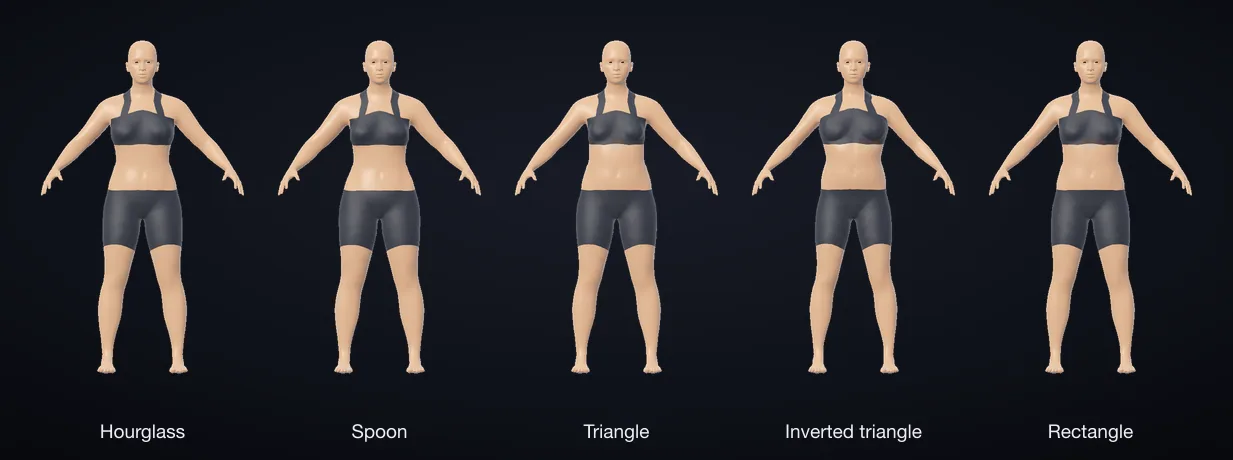
The body shape types used in clothing research are hourglass, bottom hourglass, top hourglass, spoon, triangle, inverted triangle and rectangle. Each one is set by how far the bust, waist and hips differ. The main cut-offs are 3.6 inches (9.1 cm) between bust and hips, and 9 and 10 inches (22.9 and 25.4 cm) at the waist. Two more, oval and diamond, cover a midsection that is large next to the rest of the body.
Where the classes come from
Simmons, Istook and Devarajan of North Carolina State University published the Female Figure Identification Technique (FFIT) for Apparel in 2004. It is a program that reads bust, waist, hip, high hip, stomach and abdomen girths from a 3D body scan and names one of nine shapes. The first version had five: hourglass, oval, triangle, inverted triangle and rectangle. Many of the 222 scans fitted none of them, so the authors added spoon, diamond, bottom hourglass and top hourglass.
The 2004 papers describe each shape in words and keep the numbers inside the program. A 2007 study by Lee, Istook, Nam and Park used inch cut-offs for seven of the shapes. Sokolowski and Bettencourt (2020) and Parker and colleagues (2021) reprint those formulas, and Parker's team describes them as the algorithm the 2004 program used. FFIT was written to sort bodies for clothing fit. It is not a health measure.
The seven rules in inches and centimeters
| Shape | Bust against hips | Waist difference | High hip |
|---|---|---|---|
| Hourglass | Bust at most 1 in (2.5 cm) larger, hips under 3.6 in (9.1 cm) larger | Bust 9 in (22.9 cm) or hips 10 in (25.4 cm) larger than waist | Not used |
| Bottom hourglass | Hips 3.6 in to under 10 in (9.1 to 25.4 cm) larger | Hips 9 in (22.9 cm) or more larger than waist | Under 1.193 times waist |
| Top hourglass | Bust over 1 in and under 10 in (2.5 to 25.4 cm) larger | Bust 9 in (22.9 cm) or more larger than waist | Not used |
| Spoon | Hips over 2 in (5.1 cm) larger | Hips 7 in (17.8 cm) or more larger than waist | 1.193 times waist or more |
| Triangle | Hips 3.6 in (9.1 cm) or more larger | Hips under 9 in (22.9 cm) larger than waist | Not used |
| Inverted triangle | Bust 3.6 in (9.1 cm) or more larger | Bust under 9 in (22.9 cm) larger than waist | Not used |
| Rectangle | Bust and hips within 3.6 in (9.1 cm) | Bust under 9 in (22.9 cm) and hips under 10 in (25.4 cm) larger than waist | Not used |
The program checks the rules in that order and stops at the first one that holds. A body that fits none is left unclassed: Lee's team reported 5 such women among more than 6,300 in the US sample. The high hip is the largest girth in the top quarter of the distance from the crotch up to the waist. It only separates spoon from bottom hourglass.
The reprints differ at a few edges. Sokolowski and Bettencourt put a high hip of exactly 1.193 times the waist in spoon, and Parker's table needs more than 1.193. Parker's team also prints the cut-offs in centimetres: 9.14, 22.86 and 25.4. The body shape calculator follows the Sokolowski and Bettencourt wording and lists every rule beside the numbers entered.
Oval and diamond
In the 2004 papers a diamond has an average of stomach, waist and abdomen girths larger than the bust. An oval has a large midsection too, but that average is smaller than the bust. The 2007 formulas leave both out. Sokolowski and Bettencourt brought them back in 2020 for plus-size scans, using three measurements only. A waist larger than the hips is an oval when the bust is at least as large as the waist. It is a diamond when the waist is larger than the bust as well. The calculator applies those two rules before the other seven.
Pear, apple and banana are informal names
Fruit and letter names come from magazines, books and websites, and they have no cut-offs of their own. The 2004 paper sorted the common ones into groups.
| Everyday names | Group in the 2004 paper |
|---|---|
| Pear, spoon, "A" frame, Christmas tree | Triangle |
| Apple, circle or round, diamond, "O" frame | Oval |
| Ruler, "H" frame | Rectangle |
| Figure 8, "X" frame | Hourglass |
| Cone, "V" frame | Inverted triangle |
A pear body shape therefore points to hips larger than the bust, and the measured rules split such figures three ways: bottom hourglass, spoon and triangle. An apple body shape points to the oval and diamond classes. Banana is not in the 2004 list. It is an informal name for the straight figure, the rectangle body shape.
Five classes drawn at one height and weight
Five of the classes, drawn at 165 cm and 65 kg, differ in girths alone.
| Class | Bust | Waist | Hips | What decides it |
|---|---|---|---|---|
| Hourglass | 98 cm (38.6 in) | 72 cm (28.3 in) | 100 cm (39.4 in) | Bust 10.2 in larger than waist |
| Spoon | 92 cm (36.2 in) | 68 cm (26.8 in) | 104 cm (40.9 in) | Hips 4.7 in over bust, high hip 1.213 times waist |
| Triangle | 88 cm (34.6 in) | 82 cm (32.3 in) | 102 cm (40.2 in) | Hips 5.5 in over bust, 7.9 in over waist |
| Inverted triangle | 104 cm (40.9 in) | 84 cm (33.1 in) | 93 cm (36.6 in) | Bust 4.3 in over hips, 7.9 in over waist |
| Rectangle | 96 cm (37.8 in) | 80 cm (31.5 in) | 98 cm (38.6 in) | Hips 0.8 in over bust, bust 6.3 in over waist |
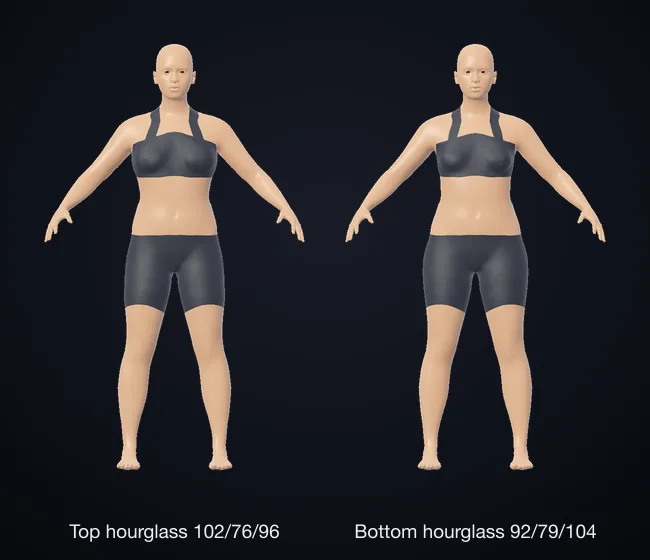
The two remaining classes sit on either side of the hourglass. The top hourglass at 102, 76 and 96 cm has a bust 2.4 inches larger than the hips and 10.2 inches larger than the waist. The bottom hourglass at 92, 79 and 104 cm has the same bust and hips as the spoon. Its high hip of 89.4 cm is 1.132 times the waist, under the 1.193 line, so the class changes. Any set of measurements can be drawn the same way in the 3D body visualizer.
Worked example: 36, 29 and 40 inches
Take a bust of 36 in (91.4 cm), a waist of 29 in (73.7 cm), a high hip of 35.5 in (90.2 cm) and hips of 40 in (101.6 cm). The hips are 4 inches larger than the bust, so the hourglass rule fails at its 3.6 inch limit. Bottom hourglass passes on bust and waist, since the hips are 11 inches larger than the waist. It fails on the high hip, which is 1.224 times the waist when the rule needs less than 1.193. Top hourglass fails because the bust is smaller than the hips.
Spoon is next. It asks for hips more than 2 inches larger than the bust and at least 7 inches larger than the waist. The high hip must be at least 1.193 times the waist. Every condition holds, so the class is spoon. With a high hip of 34 in (86.4 cm) the ratio would be 1.172 and the class would be bottom hourglass.
Which shapes are most and least common
| Class | US, 222 scans (2004) | US, 531 SizeUSA scans (2004) | US, over 6,300 women (2006) | UK, 1,679 scans (2021) |
|---|---|---|---|---|
| Hourglass | 48 (21.6%) | 99 (18.6%) | 8% | 518 (30.9%) |
| Bottom hourglass | 89 (40.1%) | 93 (17.5%) | not printed | 447 (26.6%) |
| Top hourglass | 0 | 20 (3.8%) | not printed | 62 (3.7%) |
| Spoon | 38 (17.1%) | 73 (13.7%) | a little over 20% | 194 (11.6%) |
| Triangle | 4 (1.8%) | 15 (2.8%) | not printed | 22 (1.3%) |
| Inverted triangle | 0 | 5 (0.9%) | nearly 14% | 10 (0.6%) |
| Rectangle | 35 (15.8%) | 162 (30.5%) | about 46% | 425 (25.3%) |
| Oval | 8 (3.6%) | 59 (11.1%) | no such class | not classed |
| Diamond | 0 | 5 (0.9%) | no such class | not classed |
The answer depends on the sample. Rectangle is the largest class in both US survey counts. The larger one is an analysis of more than 6,300 women that North Carolina State University released in 2006. Lee's team found the same in both the US and Korea, though their abstract gives no shares. The 222-scan sample was mostly North Carolina students, and bottom hourglass led it. Among the UK women the hourglass body shape came first, and one woman of the 1,679 fitted no class.
The least common shape is less clear. The inverted triangle body shape has the smallest count of the seven in the three samples with printed counts, yet it holds nearly 14 percent of the 2006 analysis. The first two samples were sorted into nine classes and the 2006 one into seven, with no oval or diamond.
Where the tape sits changes the shares. Parker and colleagues classed all 1,679 women under three sets of tape positions. Between 21.9% and 39.6% of them changed class from one set to another.
What exists for men
No agreed standard turns a man's chest, waist and hip measurements into a shape name. FFIT covers women only. The sizing standards that Chun (2012) compared sort men by drop, which is chest minus waist. ISO/TR 10652:1991 starts at an athletic type with a 16 cm drop and a regular type at 12 cm. It ends at a corpulent type whose waist is 6 cm larger than the chest.
Research surveys form their own groups. Tiwari and Anand (2024) grouped the valid scans of 12,546 Indian men into three: trapezoid at 41.06%, inverted trapezoid at 34.92% and rectangle at 24.02%. For a man, the body shape calculator reports the drop and gives no shape name.
Body types are a separate scheme. Ectomorph, mesomorph and endomorph date from William Sheldon's books of 1940 and 1942 and rate a body's build with three numbers.