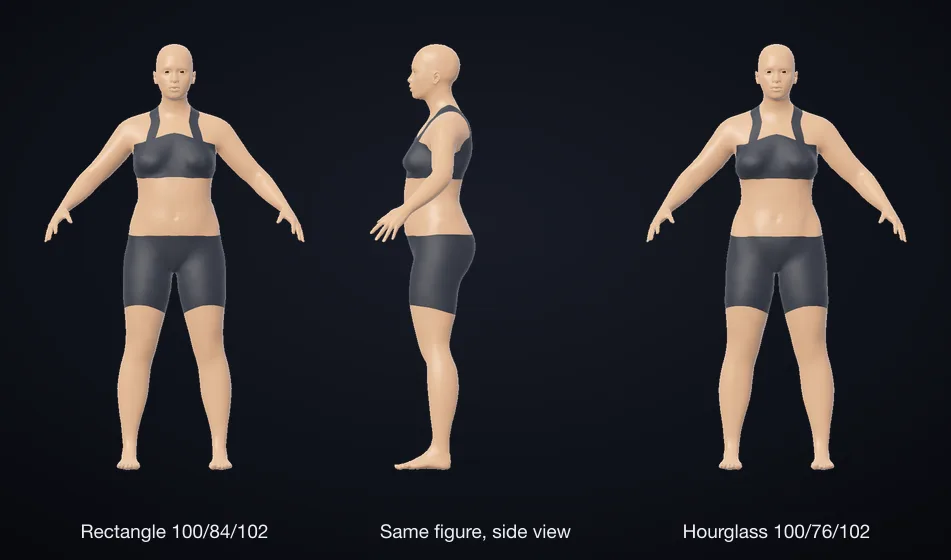
A rectangle body shape, also called straight, has a bust and hips within 3.6 inches (9.1 cm) of each other. The waist is not much smaller than either. In the rules from clothing research, the bust is less than 9 inches (22.9 cm) larger than the waist and the hips less than 10 inches (25.4 cm) larger. It is the largest class in US sizing survey samples, at about 46 percent of more than 6,300 women in a 2006 analysis.
The measurements that define a rectangle
Simmons, Istook and Devarajan of North Carolina State University named the class in 2004, in the Female Figure Identification Technique (FFIT). They describe a rectangle as a bust and hips that are fairly equal, with low bust-to-waist and hip-to-waist ratios. The waistline is not clearly discernible, so bust, waist and hips sit close to one line.
Numbers were put on that description in 2007 by Lee, Istook, Nam and Park, and two later studies reprint their formulas. All four conditions must hold.
| Condition | Inches | Centimeters |
|---|---|---|
| Hips minus bust | less than 3.6 | less than 9.1 |
| Bust minus hips | less than 3.6 | less than 9.1 |
| Bust minus waist | less than 9 | less than 22.9 |
| Hips minus waist | less than 10 | less than 25.4 |
The 2004 program checks the rectangle last, after the six other measured classes, and a figure that fails all seven gets no shape. The body shape calculator runs the same seven checks and marks which rule held.
A 2020 revision by Sokolowski and Bettencourt adds a floor. They found the 2007 formulas called some plus-size scans rectangles when the waist was larger than the bust or the hips. Their version requires a waist no larger than either, and it sends a waist larger than the hips to the oval or diamond class.
The class has other names. The 2004 paper lists ruler and "H" frame with it and counts straight among the common shape words. Banana is an informal name for the same straight figure and is not in that list. The US sizing standard uses the word too: ASTM D5585-11 splits misses sizes into Curvy and Straight. As summarized by Chun (2012), the Straight figure has a bust 19.1 to 22.9 cm (7.5 to 9.0 in) larger than the waist. Its hips are 14.0 to 17.2 cm (5.5 to 6.8 in) larger than the waist. Both ranges sit at or under the rectangle limits.
Worked example: 100, 84 and 102 cm
A bust of 100 cm (39.4 in), a waist of 84 cm (33.1 in) and hips of 102 cm (40.2 in) give three differences. The hips are 2 cm (0.8 in) larger than the bust. The bust is 16 cm (6.3 in) larger than the waist, and the hips are 18 cm (7.1 in) larger than the waist. Every condition holds, so the class is rectangle.
Keep the bust and hips and reduce the waist. The class stays rectangle down to a waist of 77.2 cm. At 77.1 cm (30.4 in) the bust reaches 9 inches larger than the waist and the hourglass rule takes over. With a 76 cm (29.9 in) waist, the bust is 24 cm (9.4 in) larger and the hips are 26 cm (10.2 in) larger. Both figures are drawn at 165 cm and 70 kg.
The class follows differences, not size
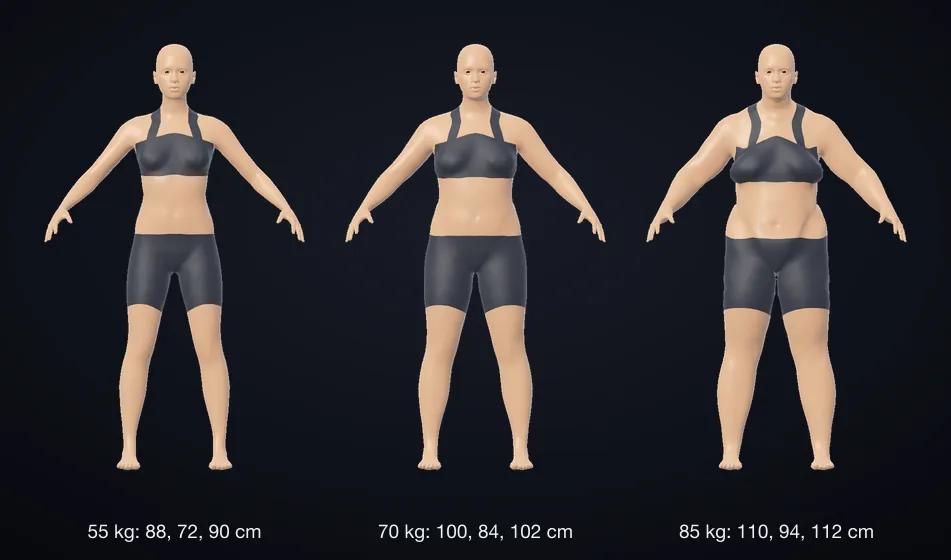
Three figures of 165 cm at 55, 70 and 85 kg can all be rectangles. Their measurements are 88, 72 and 90 cm, then 100, 84 and 102 cm, then 110, 94 and 112 cm. In each one the bust is 16 cm (6.3 in) larger than the waist and the hips are 18 cm (7.1 in) larger. The rule returns the same class at every size. Any height, weight and set of girths can be drawn in the 3D body visualizer.
Why the rectangle leads the US samples
| Sample | Women | Rectangles | Share | Place |
|---|---|---|---|---|
| North Carolina sample used to build FFIT, 2004 | 222 | 35 | 15.8% | 4th |
| Random draw from the SizeUSA survey, 2004 | 531 | 162 | 30.5% | 1st |
| North Carolina State University analysis, 2006 | more than 6,300 | not printed | about 46% | 1st |
| UK scans with FFIT tape positions, 2021 | 1,679 | 425 | 25.3% | 3rd |
| Same UK women with SizeUK tape positions | 1,679 | 779 | 46.4% | 1st |
The 46 percent figure comes from a North Carolina State University news release of February 2006. Lee and co-authors (2007) also classed over 6,300 US women from SizeUSA. They found the rectangle the largest class in both the US and Korea, though their abstract gives no percentage. Newcomb and Istook (2006) named it the most common shape among the SizeUSA women, with over half of those aged 18 to 25.
The rule itself is one reason. Rectangle takes every figure with balanced bust and hips whose waist difference falls short of 9 inches at the bust and 10 inches at the hips. It is also the last class checked.
The number of classes differs too. The 2004 draw used the nine-class program, which put 59 of the 531 women in the oval class. The 2006 analysis used seven classes with no oval or diamond, and Sokolowski and Bettencourt found that the seven formulas class some large-waist scans as rectangles.
US size tables also record waists growing faster than busts and hips. Chun compares junior size 11 in the 1970 and 2008 standards: the bust grew 5.0 cm, the hips 6.4 cm and the waist 10.2 cm. Chun reads the change as women's waists getting bigger than in the past. Even so, Newcomb and Istook found that the misses and junior standards classed as hourglass at every size, while most scanned women did not.
Tape placement moves the count as well. In the UK study by Parker and colleagues, FFIT's tape positions gave 425 rectangles among 1,679 women. The SizeUK positions, which set the waist and hips at other levels, gave 779 among the same women. The share also changes with the sample: the North Carolina women used to build FFIT were mostly students, and only 15.8% were rectangles.
Rectangle for men
FFIT was built from women's scans, and the sizing standards that Chun compared sort men by chest minus waist, not by shape name. Research on men's scans does use the word. Tiwari and Anand (2024) placed 24.02% of 12,546 Indian men in a rectangle group, the smallest of their three groups. Its chest was 0 to 3 cm larger than the waist and within 3 cm of the hips. The ranges come from that survey alone.