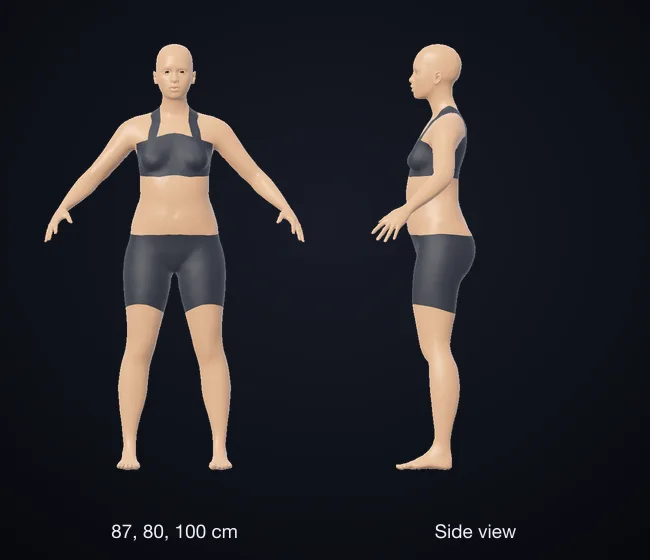
A pear body shape, also called a triangle, has hips clearly larger than the bust. Pear is an informal name, and the formulas used in clothing research have no class called pear. They define the nearest shapes in numbers. A triangle has hips at least 3.6 in (9.1 cm) larger than the bust and less than 9 in (22.9 cm) larger than the waist. A spoon adds a sharp step out from the waist to the high hip.
What pear means in measurements
The defined shapes come from the Female Figure Identification Technique (FFIT) for Apparel, shape sorting software from North Carolina State University. It sorts 3D body scans into nine classes, and none of them is called pear. Three have hips larger than the bust: the triangle, the spoon and the bottom hourglass.
The 2004 FFIT papers describe them in words. A triangle has hips larger than the bust and no defined waistline. A bottom hourglass has hips larger than the bust and a definite waistline. A spoon has a "shelf": the waist is defined, and the high hip and hip stand out sideways right under it, where other shapes taper gradually. In 2007 Lee, Istook, Nam and Park turned the descriptions into formulas in inches.
The word pear is used loosely for all three. NC State's own 2006 news release wrote of "the spoon or pear shape". The body shape calculator, which applies the 2007 formulas, attaches the name to the triangle class. Names such as A shape, bell or teardrop are not FFIT classes, and the formulas give them no measurements.
Triangle, spoon and bottom hourglass measurements
| Shape | Hips minus bust | Hips minus waist | High hip divided by waist |
|---|---|---|---|
| Triangle | 3.6 in (9.1 cm) or more | Under 9 in (22.9 cm) | Not used |
| Spoon | More than 2 in (5.1 cm) | 7 in (17.8 cm) or more | 1.193 or more |
| Bottom hourglass | 3.6 in (9.1 cm) to under 10 in (25.4 cm) | 9 in (22.9 cm) or more | Under 1.193 |
FFIT's scanner software takes the high hip as the largest girth in the top quarter of the distance from crotch to waist. The site's body model takes it the same way. The ratio 1.193 has no unit, so it reads the same in inches and centimeters.
A triangle worked out step by step
Take a figure with an 87.0 cm bust, an 80.0 cm waist and 100.0 cm hips (34.3, 31.5 and 39.4 in).
- Hips minus bust is 13.0 cm, or 5.1 in. That passes the 3.6 in test.
- Hips minus waist is 20.0 cm, or 7.9 in. That is under 9 in, so the figure is not a bottom hourglass.
- The high hip is 88.9 cm, which is 1.11 times the waist. That is under 1.193, so the figure is not a spoon.
The result is a triangle. A high hip of about 95.4 cm or more on the same figure would make it a spoon.
Pear versus spoon
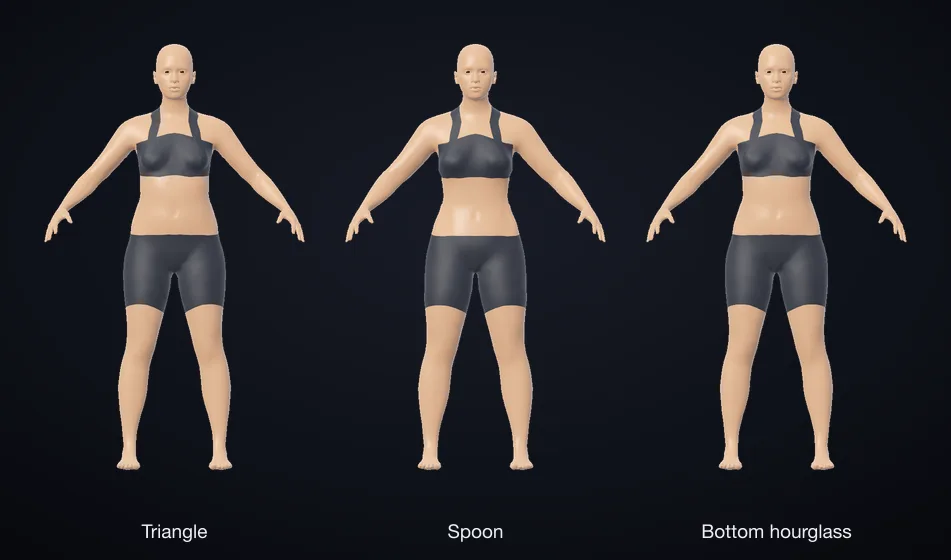
All three models have hips of 100 to 101 cm. The waist and the high hip set them apart.
The spoon measures 90.0, 64.0 and 100.0 cm (35.4, 25.2 and 39.4 in). Its hips are 14.2 in larger than its waist, and its high hip of 78.2 cm is 1.22 times the waist. That jump from waist to high hip is the shelf FFIT describes. The triangle's waist is 16 cm larger, so its line from waist to hip is straighter.
The bottom hourglass measures 89.0, 76.0 and 101.0 cm (35.0, 29.9 and 39.8 in). Its hips are 9.8 in larger than its waist, which passes the 9 in test. Its high hip is 86.1 cm, 1.13 times the waist, short of the spoon mark.
The triangle and spoon rules overlap when the hips are 7 to 9 in larger than the waist. FFIT looks for the spoon before the triangle, and so does the calculator, so the high hip ratio decides.
Tape position matters most for the spoon. A 2021 study classed 1,679 UK women with the measurements placed by FFIT's definitions, and 194 were spoons. Placed by a UK sizing survey's definitions, the same scans gave 2 spoons.
How common a pear shape is
| Sample | Triangle | Spoon | Bottom hourglass |
|---|---|---|---|
| 222 women in North Carolina, mostly students, 2004 | 1.8 percent | 17.1 percent | 40 percent |
| More than 6,300 US women, NC State analysis reported in 2006 | Not given | A little more than 20 percent | Not given |
| SizeUSA women aged 18 to 25 | Not given | About 15 percent | Not given |
| 1,679 UK women, FFIT definitions, 2021 study | 1.3 percent | 11.6 percent | 26.6 percent |
The strict triangle is rare wherever it was counted: 4 of 222 women in the 2004 sample and 22 of 1,679 in the UK study. In the NC State analysis the spoon was the second largest group after the rectangle, which made up about 46 percent.
Some figures with large hips fit no class. In the 2007 study, five of more than 6,300 US women matched none of the seven shapes. Each had hips over 50.2 in (127.5 cm). Those hips were more than 10 in (25.4 cm) larger than the bust and more than 15.5 in (39.4 cm) larger than the waist.
Newcomb and Istook ran three ASTM size standards through FFIT. Only the tables for women over 55 (D5586) matched a mix of spoon and rectangle shapes. The Misses and Juniors tables matched an hourglass in every size.
Waist to hip ratio on a pear figure
The triangle in the worked example has a waist to hip ratio of 0.80, which is 80 divided by 100. A World Health Organization report gives 0.85 or more for women as the cut-off for a substantially increased risk of metabolic complications. The US National Heart, Lung, and Blood Institute looks at where fat sits. It says fat mostly around the waist, rather than at the hips, means a higher risk of heart disease and type 2 diabetes.
Both are screening measures, and a shape class is a clothing fit label. A doctor or nurse can assess your own health. The waist to hip ratio calculator works out the ratio from two measurements, and the 3D body visualizer draws a figure from your own numbers. A waist larger than the hips belongs to a different name, the apple body shape.