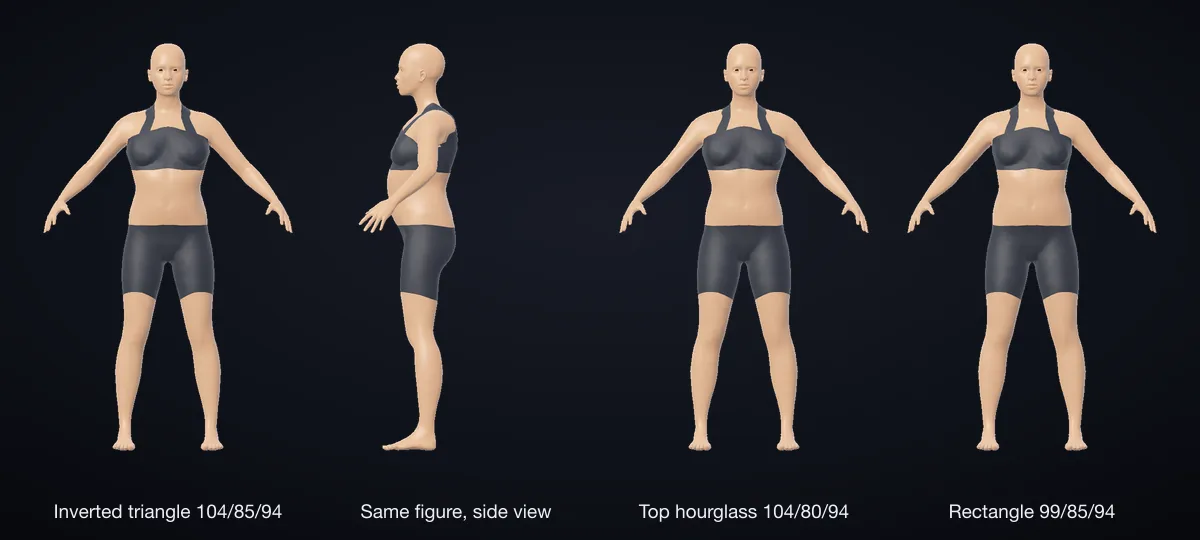
An inverted triangle body shape has a bust or chest clearly larger than the hips and a waist that is not sharply narrower. Clothing research gives women two measured conditions. The bust is at least 3.6 inches (9.1 cm) larger than the hips, and it is less than 9 inches (22.9 cm) larger than the waist. For men there is no agreed rule in numbers. Men's sizing standards sort by chest minus waist, called the drop.
The measurements that define it for women
Inverted triangle is one of nine shapes in the Female Figure Identification Technique (FFIT), a shape sorting program from North Carolina State University. Simmons, Istook and Devarajan published it in 2004. Their papers describe the shape in words: a bust larger than the hips and a small difference between bust and waist. The figure looks fuller at the bust than at the hips and has no defined waistline.
The cut-offs in inches are credited to Lee, Istook, Nam and Park (2007) by two later papers that reprint them. Both conditions must hold.
| Measurement | Inches | Centimeters |
|---|---|---|
| Bust minus hips | 3.6 or more | 9.1 or more |
| Bust minus waist | less than 9 | less than 22.9 |
Three tape measurements feed the rule. In FFIT the bust is the level girth across the fullest part. The waist is the smallest girth between bust and hips, and the hips are the largest girth between the waist and the crotch. Shoulder width is not used. The same two conditions run in the body shape calculator, which lists each rule beside the numbers entered.
The name is also used loosely. The 2004 paper's list of common figure names groups inverted triangle with cone and "V" frame. It describes them as shoulders wider than hips, with a large chest and narrow hips, and gives no numbers.
How it differs from a top hourglass
A top hourglass also has a bust larger than the hips. The waist separates the two classes: a top hourglass has a bust at least 9 inches (22.9 cm) larger than the waist.
| Class | Bust minus hips | Bust minus waist |
|---|---|---|
| Inverted triangle | 3.6 in (9.1 cm) or more | under 9 in (22.9 cm) |
| Top hourglass | over 1 in and under 10 in (2.5 to 25.4 cm) | 9 in (22.9 cm) or more |
| Rectangle | under 3.6 in (9.1 cm) | under 9 in (22.9 cm) |
| Hourglass | 1 in (2.5 cm) or less | 9 in (22.9 cm) or more |
A rectangle also needs hips less than 10 inches (25.4 cm) larger than the waist. An hourglass can qualify through hips at least 10 inches larger than the waist instead. A bust-larger figure under both lines is a rectangle body shape.
The 2004 program checks for top hourglass before inverted triangle. Its authors noted that a figure that just misses top hourglass usually ends up an inverted triangle, for lack of waist definition. The seven rules leave one gap on this side. A bust 10 inches (25.4 cm) or more larger than the hips fits no class when the waist difference is 9 inches or more.
Worked example: 104, 85 and 94 cm
Take a bust of 104 cm (40.9 in), a waist of 85 cm (33.5 in) and hips of 94 cm (37.0 in). The bust is 10 cm (3.9 in) larger than the hips, past the 3.6 inch line. It is 19 cm (7.5 in) larger than the waist, short of 9 inches. Both conditions hold, so the class is inverted triangle.
Now change one number at a time. With the waist at 80 cm (31.5 in), the bust is 24 cm (9.4 in) larger than the waist and the class becomes top hourglass. Put the waist back at 85 cm and lower the bust to 99 cm (39.0 in). The bust is then only 5 cm (2.0 in) larger than the hips, and the class becomes rectangle. Drawn at 168 cm and 66 kg, the three sets of numbers give figures that differ only at the bust and waist. The 3D body visualizer draws any other set of measurements in the same way.
How common the inverted triangle is
The published counts disagree widely.
| Sample | Women | Inverted triangles | Share |
|---|---|---|---|
| North Carolina sample used to build FFIT, 2004 | 222 | 0 | 0% |
| Random draw from the SizeUSA survey, 2004 | 531 | 5 | 0.9% |
| North Carolina State University analysis, 2006 | more than 6,300 | not printed | nearly 14% |
| UK scans with FFIT tape positions, 2021 | 1,679 | 10 | 0.6% |
| Same UK women with SizeUK tape positions | 1,679 | 21 | 1.3% |
The 14 percent figure comes from a university news release of February 2006, which describes the shape as a bust three or more inches larger than the hips. It made inverted triangle the third largest group, after rectangle at about 46 percent and spoon at a little more than 20 percent. A conference paper by Newcomb and Istook the same year gives the same order for the SizeUSA women. It puts inverted triangle second among women over 55.
The samples were sorted in different ways and drawn from different groups. Both 2004 counts used the nine-class program, which placed 59 of the 531 women in the oval class. The 2006 analysis used seven classes with no oval or diamond. Sokolowski and Bettencourt later found that the seven formulas class some large-waist scans as inverted triangles or rectangles. The UK women had a mean age of 31.5, and the North Carolina sample was mostly students.
The UK study by Parker and colleagues compared three sets of tape positions. Agreement for the inverted triangle was 100% in each comparison, the highest of any class. That study also measured shoulders, which the rules leave out. Inverted triangles had the widest shoulder-to-shoulder measurement, 44 cm, against about 37 cm on average for the hourglass, bottom hourglass, spoon and triangle classes.
Inverted triangle for men
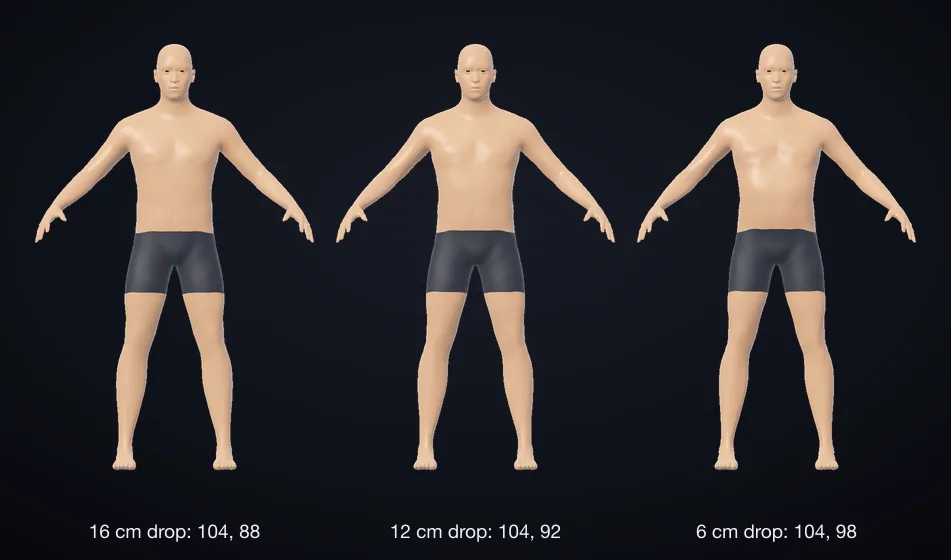
Only women were scanned to build FFIT, so the 3.6 and 9 inch lines do not transfer to men. Chun (2012) compared the sizing standards of the US, UK, Germany, Japan, Korea and ISO. None of them uses shape names such as triangle for men. They set men's build types by drop. ISO/TR 10652:1991 sets five male types. Athletic has a 16 cm drop, regular 12 cm, portly 6 cm and stout 0 cm, and the corpulent type has a waist 6 cm larger than the chest. The US standard ASTM D6240-98 defines no body types and holds the drop close to 15 cm (6 in) across sizes 34 to 45.
Research on men's scans uses other names. A 2024 survey by Tiwari and Anand, with valid scans of 12,546 Indian men, found three groups and no inverted triangle. Its closest group is the inverted trapezoid, with 34.92% of the men. In that group the chest was 7 to 9 cm larger than the waist and up to 7 cm larger than the hips. The ranges belong to that one survey and are not a standard. For a man, the body shape calculator reports the drop and the chest to hip difference and gives no shape name.