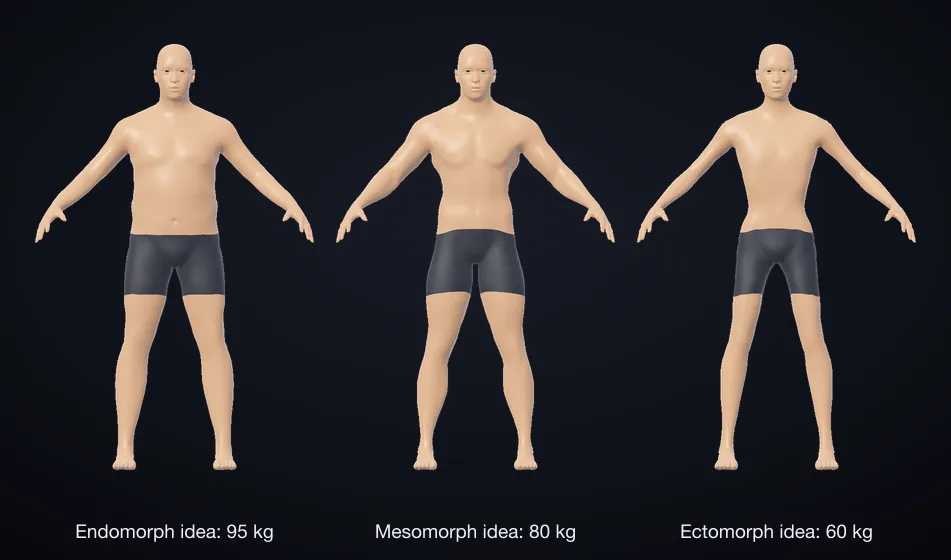
Ectomorph, mesomorph and endomorph name three directions a physique can lean: slender and linear, muscular and sturdy, or round and soft. Psychologist William Sheldon set them out in books published in 1940 and 1942. The method used today, called Heath-Carter, rates every body on all three at once with three numbers, such as 3-5-2. Each person is a mix of the three, and the numbers can change with training.
What the three somatotype components mean
| Component | Carter's definition | Sheldon's 1942 description |
|---|---|---|
| Endomorphy | Relative fatness | Softness and roundness |
| Mesomorphy | Relative musculo-skeletal robustness | Uprightness and sturdiness |
| Ectomorphy | Relative linearity or slenderness | Linearity and fragility |
A rating always lists the components in that order: endomorphy, mesomorphy, ectomorphy. A 3-5-2 is read as three, five, two. In Carter's manual a score of ½ to 2½ is low and 3 to 5 is moderate. A score of 5½ to 7 is high, and 7½ or more is very high.
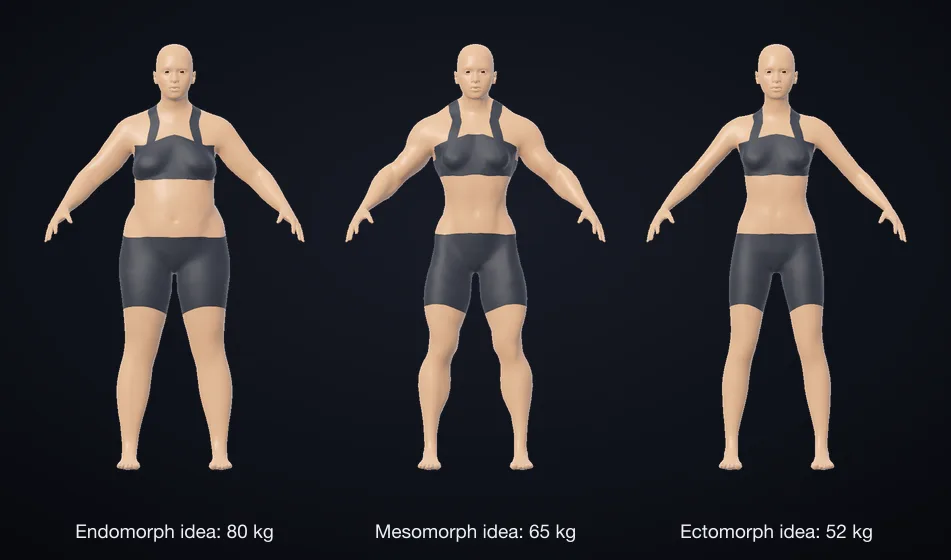
The pictures show the idea and are not ratings. Each set keeps one height and changes the weight and the body model's build setting. The male figures are 178 cm (5 ft 10) at 95 kg, 80 kg and 60 kg. The female figures are 165 cm (5 ft 5) at 80 kg, 65 kg and 52 kg.
Where the idea came from: William Sheldon in the 1940s
Sheldon gathered 4,000 photographs of college students and sorted them by eye. He wrote that he found no types, only dimensions along which bodies vary, and he scored three of them on a 7-point scale. A 7-1-1 was the most extreme endomorph, a 1-7-1 the most extreme mesomorph and a 1-1-7 the most extreme ectomorph.
The names come from the three cell layers of the early embryo. Sheldon tied endomorphy to the digestive organs, which grow from the endoderm. He tied mesomorphy to bone, muscle and connective tissue, from the mesoderm. Ectomorphy he tied to the skin and nervous system, from the ectoderm.
His 1942 book went further and gave each component a temperament. Viscerotonia meant relaxation, comfort and sociability. Somatotonia meant vigorous, assertive activity. Cerebrotonia meant restraint and inhibition. In 200 young men he reported correlations of +.79, +.81 and +.83 between the body scores and the temperament scores.
What was wrong with Sheldon's claims
The temperament link stands on weak ground. All 200 men were white college students or graduates. The investigator who rated temperament could see each man's body while doing it. Sheldon's own book concedes that this risk, which psychologists call the halo error, could not be fully excluded.
Sheldon also treated the somatotype as fixed for life. He wrote that a starved endomorph would not turn into an ectomorph "any more than a starved mastiff will change into a spaniel or a collie." He reported that no change in nutrition had moved anyone to a different somatotype, even after a weight change of 100 pounds. Later measurements of twins and athletes do not support that.
His wider views cost him support. A 2007 paper in the Canadian Bulletin of Medical History says Sheldon equated physique with destiny and held eugenic views. In the years after World War II this made him increasingly unpopular. It adds that his former assistant, Barbara Honeyman Heath, publicly called his methods fraudulent and his somatotypes inaccurate. She then went on to modify the technique.
How the Heath-Carter method rates a physique today
Heath and J. E. L. Carter published their modified method in 1967. Carter's 2002 manual describes it as the most commonly used method of somatotyping. It defines the somatotype as the present shape and composition of the body, so a rating describes a body on the day it is measured.
The rating needs ten measurements: height, weight, four skinfolds, two bone breadths and two girths.
- Endomorphy comes from the sum of the triceps, subscapular and supraspinale skinfolds, adjusted for height.
- Mesomorphy comes from the breadths of the humerus and femur and the girths of the flexed arm and the calf, set against height.
- Ectomorphy comes from the height-weight ratio: height in centimeters divided by the cube root of weight in kilograms.
Ectomorphy is the one component that needs no calipers. When the height-weight ratio is 40.75 or more, ectomorphy is 0.732 times the ratio, minus 28.58. Between 38.25 and 40.75 it is 0.463 times the ratio, minus 17.63. At 38.25 or less it is set at 0.1.
| Male figure | Height and weight | Height-weight ratio | Ectomorphy |
|---|---|---|---|
| Lean | 178 cm, 60 kg | 45.47 | 4.7 |
| Muscular | 178 cm, 80 kg | 41.31 | 1.7 |
| Heavier | 178 cm, 95 kg | 39.01 | 0.4 |
For the 60 kg figure, the cube root of 60 is 3.915, and 178 divided by 3.915 is 45.47. Then 0.732 times 45.47 is 33.28, and 33.28 minus 28.58 is 4.7. The other two components cannot be read from a picture or from height and weight, which is why the figures carry no rating.
Carter's manual sorts ratings into 13 categories and four simpler ones. A central somatotype has no component more than one unit from the other two. In the manual's sense, an endomorph, a mesomorph or an ectomorph has one component in the lead. The other two are more than half a unit lower. Some ratings cannot exist: the manual names 2-2-2 and 7-8-7 as impossible.
Why a person is a mix and can change
Every rating carries all three numbers, and no component can be rated zero. The two people worked through in Carter's manual are rated 1½-5½-3 and 3-2-5. The manual calls the first an ecto-mesomorph and the second an endo-ectomorph.
Genes set part of the rating. A study of 803 adult twins from 424 Flemish pairs estimated the genetic share of the variation in each component. In men it was 28.0 percent for endomorphy, 86.3 percent for mesomorphy and 66.5 percent for ectomorphy. In women the shares were 32.3, 82.0 and 70.1 percent. Fatness was the least inherited of the three.
Training moves the numbers. One study measured 17 elite male basketball players at the start and end of a five-week pre-season. Average endomorphy fell from 2.84 to 2.51 and ectomorphy rose from 2.88 to 2.99. Mesomorphy stayed at 4.72. A 2025 review of 40 sources also reports that endomorphy and mesomorphy scores rise in adults up to the age of 60.
You can see how weight and build change a figure of your own height in the 3D body visualizer. Since endomorphy is a measure of fatness, the body fat calculator gives a related number from a tape measure.
No evidence for somatotype diets
Diet plans built on body type tell each somatotype to eat differently. The Heath-Carter manual is a measuring method and gives no diet advice.
The papers PubMed lists on somatotype and diet are mostly descriptions of what athletes and other groups already eat. One of them surveyed 189 elite Lithuanian athletes once, using three-day food records. A single survey can show a pattern in who eats what. It cannot show that a diet suits a body type. None of the listed papers is a trial that assigns people a diet by somatotype and compares them with a control group.
A doctor or nurse can assess your own health and what you eat.