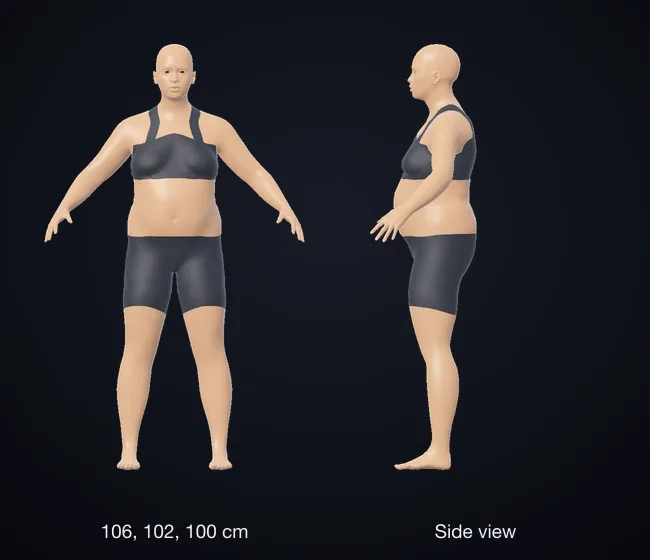
An apple body shape, also called round or oval, has its largest girth at the waist. Apple is an informal name, and the seven formula shapes used in clothing research have no class for it. An apple figure comes out of them as a rectangle or an inverted triangle. A 2020 extension adds two classes for a waist larger than the hips. The figure is an oval when the bust is at least as large as the waist. It is a diamond when the waist is larger than the bust too.
How an apple shape is defined without an apple class
The Female Figure Identification Technique (FFIT) for Apparel, built at North Carolina State University, sorts 3D body scans into nine shapes. Two of them describe a large midsection. The 2004 FFIT papers split them with one test: the average of the stomach, waist and abdomen girths against the bust. A larger average makes a diamond, and a smaller one makes an oval. The papers add that an oval can look different from the front on each person and shows most clearly from the side.
Both classes were left out when the shapes were written as formulas. Lee, Istook, Nam and Park published formulas for seven shapes in 2007, with no oval and no diamond. Sokolowski and Bettencourt reprinted the formulas in 2020 and suggest the reason was missing stomach and abdomen data. A 2004 validation paper had found the body scanner often took the stomach girth in the wrong place, in some scans almost on the bust.
The seven formulas assume a waist smaller than the bust and the hips. Sokolowski and Bettencourt sorted plus size body scans with them. Bodies with a larger waist came out as rectangles or inverted triangles, and some fit no shape. Their fix was two new rules.
Oval and diamond measurements
| Shape | Waist against hips | Waist against bust | Bust against hips |
|---|---|---|---|
| Oval | Waist larger | Waist equal or smaller | Any |
| Diamond | Waist larger | Waist larger | Any |
| Rectangle | Waist 0 to under 10 in (25.4 cm) smaller | Waist under 9 in (22.9 cm) smaller | Within 3.6 in (9.1 cm) |
| Inverted triangle | Waist equal or smaller | Waist under 9 in (22.9 cm) smaller | Bust 3.6 in (9.1 cm) or more larger |
The oval and diamond tests only ask which girth is larger, so they work the same in inches and centimeters. The body shape calculator applies these rules and shows an oval or a diamond when the waist is larger than the hips. Round, O shape and apple are informal names for the same idea, and the formulas give them no measurements.
Three figures on either side of the line
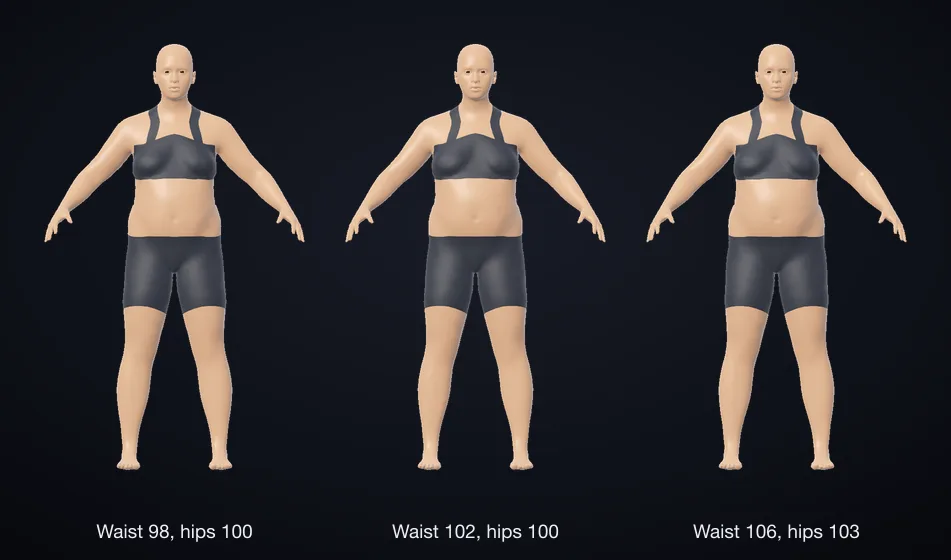
The three models are all 165 cm tall.
The first measures 102.0, 98.0 and 100.0 cm for bust, waist and hips (40.2, 38.6 and 39.4 in). Its waist is 2 cm smaller than its hips, so it is not an oval. Its bust and hips are within 3.6 in, and its waist is under 9 in smaller than the bust. That makes it a rectangle.
The second measures 106.0, 102.0 and 100.0 cm (41.7, 40.2 and 39.4 in). Its waist is 2 cm larger than its hips and 4 cm smaller than its bust, so it is an oval. The seven formulas alone would call it a rectangle.
The third measures 104.0, 106.0 and 103.0 cm (40.9, 41.7 and 40.6 in). Its waist is larger than both its hips and its bust, which is a diamond.
The 2020 paper gives a measured case too. One size 16 body scan had a bust 4.88 in larger than the hips and a waist 0.71 in larger than the hips. The seven formulas classed it as an inverted triangle, and the new rules class it as an oval.
How common an apple shape is
Published counts for these shapes are scarce. Among the 222 women scanned for the 2004 FFIT papers, 8 were ovals (3.6 percent) and none was a diamond. One diamond turned up in a separate control set of 31 scans.
The larger samples used the seven formula shapes, which have neither class. NC State's 2006 release on more than 6,300 US women lists seven shapes, and apple is not one of them. Its nearly 14 percent figure belongs to the inverted triangle, a bust at least 3.6 in larger than the hips.
Waist size itself is well recorded. In the 2015 to 2018 US national health survey (NHANES), the mean waist of women aged 20 and over was 98.4 cm (38.7 in). The median was 96.4 cm (38.0 in). The same report has no hip girth table, so it cannot show how many waists are larger than the hips.
Why waist size matters for health
Shape classes were built for clothing fit. Waist size is also used in health screening, because body mass index leaves out where fat sits. The CDC states that BMI does not indicate where in the body people carry fat.
The US National Heart, Lung, and Blood Institute (NHLBI) puts it plainly. If most of your fat is around your waist and not your hips, your risk of heart disease and type 2 diabetes is higher. Three organizations publish marks.
| Measure | Source | Women | Men | What the source says |
|---|---|---|---|---|
| Waist | NHLBI | Over 35 in (88.9 cm) | Over 40 in (101.6 cm) | Increased risk of heart disease and type 2 diabetes |
| Waist | WHO report | Over 80 cm (31.5 in) | Over 94 cm (37.0 in) | Increased risk of metabolic complications |
| Waist | WHO report | Over 88 cm (34.6 in) | Over 102 cm (40.2 in) | Substantially increased risk |
| Waist to hip ratio | WHO report | 0.85 or more | 0.90 or more | Substantially increased risk |
| Waist to height ratio | NICE | 0.5 to 0.59 | 0.5 to 0.59 | Increased central adiposity |
| Waist to height ratio | NICE | 0.6 or more | 0.6 or more | High central adiposity |
The sources differ in detail. The WHO report says its waist values came from a Dutch sample and were given as an example, not as a WHO recommendation. NICE, the UK guideline body, uses the waist to height ratio for adults with a BMI under 35, for both sexes and all ethnicities. It calls 0.4 to 0.49 healthy central adiposity and links higher bands to type 2 diabetes, hypertension and cardiovascular disease. Its plain version is to keep your waist to less than half your height.
Tape position differs too. NHLBI places the tape around the middle at the top of the hipbones. WHO and NICE measure midway between the lowest rib and the top of the hip bone.
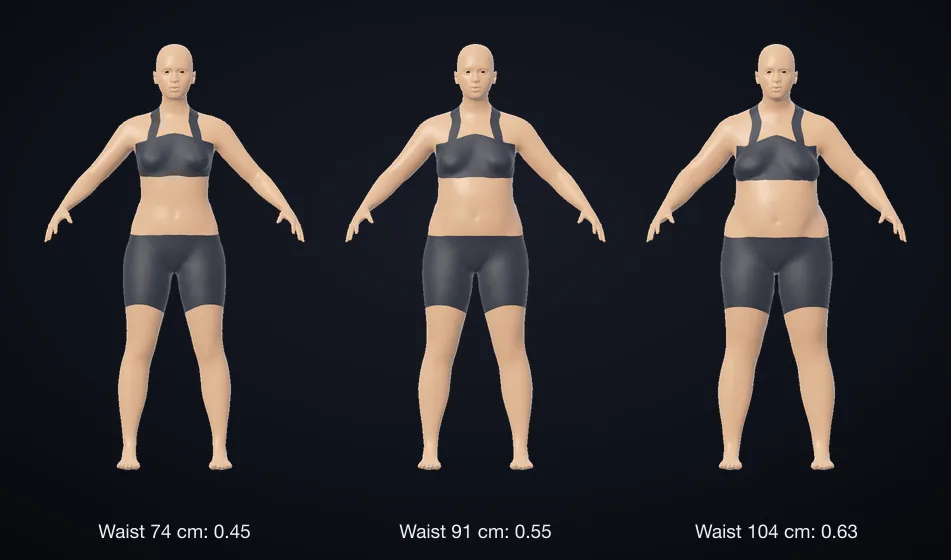
The three models stand 165 cm tall, where half the height is 82.5 cm. Their waists of 74.0, 91.0 and 104.0 cm give ratios of 0.45, 0.55 and 0.63. The oval from the three figure comparison has a 102.0 cm waist. Its waist to height ratio is 0.62 and its waist to hip ratio is 1.02.
These marks are screening measures: a way to flag possible risk, which a doctor or nurse can then assess for you. The waist to height ratio calculator and the waist to hip ratio calculator work out both ratios. The 3D body visualizer draws a figure from your own measurements. Hips larger than the bust belong to a different name, the pear body shape.