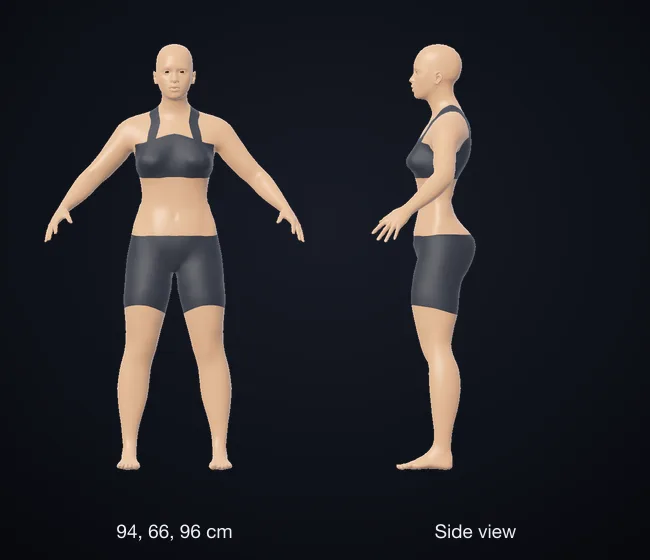
An hourglass body shape has a bust and hips of nearly the same girth and a much smaller waist. The formulas used in clothing research put numbers on it. The bust is no more than 1 in (2.5 cm) larger than the hips. The hips are less than 3.6 in (9.1 cm) larger than the bust. The waist is at least 9 in (22.9 cm) smaller than the bust, or 10 in (25.4 cm) smaller than the hips.
Where the hourglass definition comes from
The name is a class in the Female Figure Identification Technique (FFIT) for Apparel, shape sorting software built at North Carolina State University. Simmons, Istook and Devarajan described it in 2004. It sorts 3D body scans into nine shapes from six measurements: bust, waist, hips, high hip, stomach and abdomen.
The 2004 papers define the hourglass in words. The difference between bust and hip girth is very small, and both are larger than the waist by about the same clear margin. The top hourglass and the bottom hourglass are subsets, added after many of the first 222 women scanned fit no class.
The numbers came later. In 2007 Lee, Istook, Nam and Park wrote seven of the shapes as formulas in inches, to compare women measured for the SizeUSA and SizeKorea surveys. Those formulas set every cut-off given for the hourglass, and the body shape calculator applies the same ones. Labels such as figure eight, X shape or full hourglass are not FFIT classes, and the formulas give them no measurements.
Hourglass figure measurements in inches and centimeters
FFIT has three hourglass classes. They differ in whether the bust or the hips are larger.
| Shape | Bust and hips | Waist |
|---|---|---|
| Hourglass | Bust at most 1 in (2.5 cm) larger; hips under 3.6 in (9.1 cm) larger | At least 9 in (22.9 cm) smaller than the bust, or 10 in (25.4 cm) smaller than the hips |
| Top hourglass | Bust over 1 in (2.5 cm) and under 10 in (25.4 cm) larger | At least 9 in (22.9 cm) smaller than the bust |
| Bottom hourglass | Hips 3.6 in (9.1 cm) to under 10 in (25.4 cm) larger | At least 9 in (22.9 cm) smaller than the hips, with a high hip under 1.193 times the waist |
The window for a plain hourglass is not even. The hips may be almost 3.6 in larger than the bust, but the bust may be only 1 in larger than the hips. Height and weight appear in none of the rules. Only the differences between the girths count.
How to tell if you are an hourglass
- Measure the bust around its fullest part and the waist at its smallest girth between bust and hips. Measure the hips at their largest girth between waist and crotch. Those are FFIT's own definitions. Keep the tape level and use one unit throughout.
- Subtract the waist from the bust, and the waist from the hips.
- Subtract the smaller of bust and hips from the larger.
- Compare the three results with the table, or enter the measurements in the body shape calculator.
Take a figure with a 94.0 cm bust, a 66.0 cm waist and 96.0 cm hips (37.0, 26.0 and 37.8 in). The hips are 0.8 in larger than the bust, inside the 3.6 in limit. The bust is 11.0 in larger than the waist, past the 9 in mark. Both tests pass, so the figure is an hourglass. With the same bust and hips, the class holds up to a waist of 71.1 cm (28.0 in). At 72 cm the figure is a rectangle.
Tape position changes the answer. A 2021 study in the journal Ergonomics classed 1,679 UK women with the measurements placed by FFIT's definitions and by a UK sizing survey's. Up to 40 percent of the women landed in a different shape. Measure at the same places each time, and treat a result close to a cut-off as borderline.
Is 36-24-36 an hourglass?
Yes. A 36 in bust and 36 in hips are equal, and the bust is 12 in larger than a 24 in waist. In centimeters that is 91.4, 61.0 and 91.4. The metric version, 90-60-90 cm, passes too, with a bust 30 cm (11.8 in) larger than the waist.
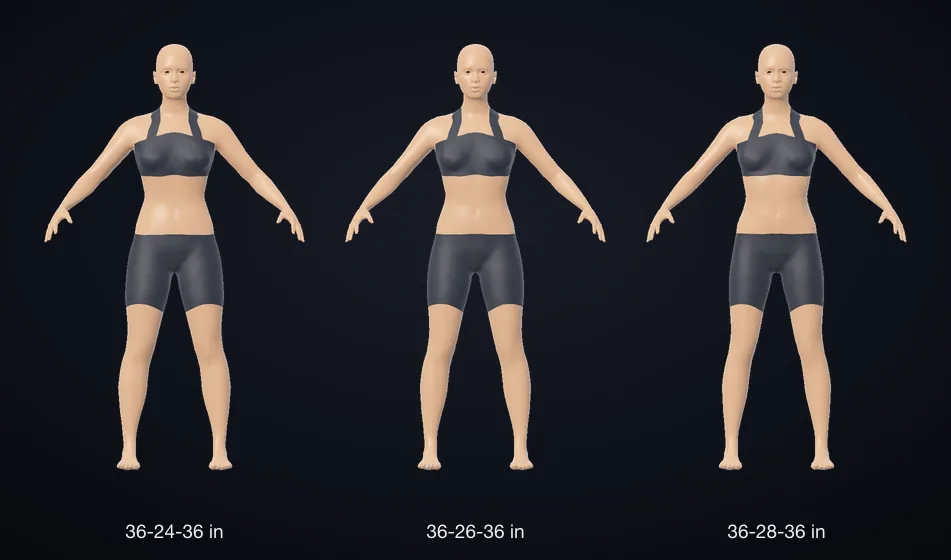
The cut-off for a 36 in bust and 36 in hips sits at a 27 in (68.6 cm) waist. A 26 in waist still passes, with the bust 10 in larger. At 28 in the bust is only 8 in larger than the waist, and the formulas call the figure a rectangle.
Hourglass versus top hourglass and bottom hourglass
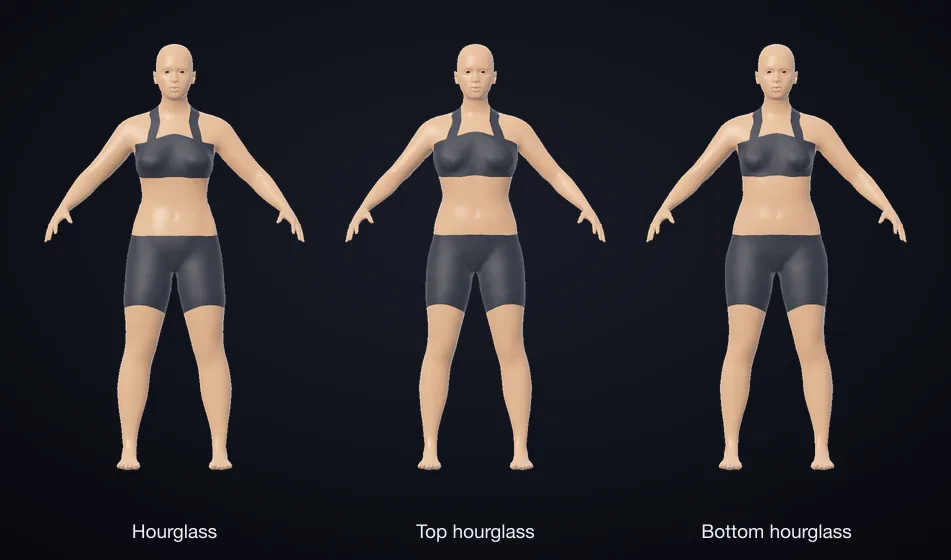
A top hourglass has a bust more than 1 in larger than the hips. The middle model measures 100.0, 72.0 and 95.0 cm (39.4, 28.3 and 37.4 in). Its bust is 2.0 in larger than its hips and 11.0 in larger than its waist.
A bottom hourglass has hips at least 3.6 in larger than the bust and at least 9 in larger than the waist. The third model measures 89.0, 76.0 and 101.0 cm (35.0, 29.9 and 39.8 in). Its hips are 4.7 in larger than its bust and 9.8 in larger than its waist.
The bottom hourglass has one more test: the high hip must be less than 1.193 times the waist. FFIT's scanner software takes the high hip as the largest girth in the top quarter of the distance from crotch to waist. The site's model reads it the same way, and the third model has a high hip of 86.1 cm, which is 1.13 times its waist. At 1.193 or more the same figure is a spoon, one of the classes behind the name pear body shape.
The hourglass rule overlaps with the spoon rule. A figure with hips 2 to 3.6 in larger than the bust can pass both tests. FFIT looks for the hourglass first, and so does the calculator. The 2004 validation paper shows one such scan: the experts saw a spoon, and the software called it an hourglass.
How common an hourglass figure is
| Sample | Classed as hourglass |
|---|---|
| 222 women in North Carolina, mostly students, 2004 | 21.6 percent |
| More than 6,300 US women, NC State analysis reported in 2006 | 8 percent |
| SizeUSA women aged 18 to 25 | 12.5 percent |
| SizeUSA women aged 26 to 55 | 8 percent |
| 1,679 UK women, 2021 study | 30.9 percent |
| Plus size body scans in sizes 16 to 28, 2020 study | None |
The share depends on who was measured and how. The 2004 sample was the 222 women scanned to build the software. The UK figure is 518 of 1,679 women under FFIT's own measurement definitions. Under the UK sizing survey's definitions it fell to 447 women, or 26.6 percent.
In the NC State analysis the rectangle was the largest group, at about 46 percent. The spoon followed at a little more than 20 percent and the inverted triangle at nearly 14 percent. The bottom hourglass led the 2004 sample with 89 of 222 women, and no one in it was a top hourglass.
Standard size tables assume the shape far more often than it occurs. When Newcomb and Istook ran the ASTM size tables for Misses (D5585) and Juniors (D6829) through FFIT, every size came out as an hourglass. Clothes cut to those tables fit an hourglass best, the authors note, while 8 percent of the women aged 26 to 55 had that shape.
To see your own numbers as a figure, enter them in the 3D body visualizer.