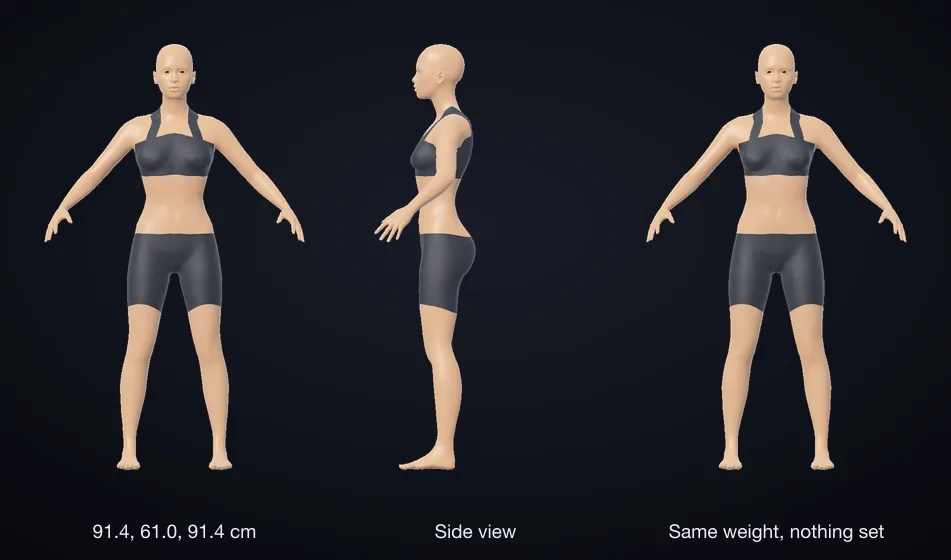
36-24-36 is a set of three body measurements in inches: a 36 inch bust, a 24 inch waist and 36 inch hips. In centimeters that is 91.4, 61.0 and 91.4, or 91-61-91 when rounded. The figure exists, but its waist is rare. The CDC measured US women aged 20 to 29 from 2015 to 2018. Of every 100, 95 had a waist larger than 69.6 cm (27.4 in).
What the three numbers measure
The order is always bust, waist, hips. The clothing standard ISO 3635 defines each one. Bust girth is the largest level girth around the chest. The tape passes over the shoulder blades, under the armpits and across the fullest part of the bust. Waist girth is taken at the natural waistline, between the top of the hip bones and the lower ribs. Hip girth is the level girth around the buttocks where it is largest.
One inch is exactly 2.54 cm, so 36 in is 91.44 cm and 24 in is 60.96 cm. The round metric figure 90-60-90 is 1.4 cm smaller at the bust and hips and 1 cm smaller at the waist. The tape position for each girth is set out in how to take body measurements.
How common a 24 inch waist is
No national survey counts how many women measure 36-24-36 as a set. The surveys report each girth on its own, so the three numbers have to be checked one at a time. The waist is the unusual one.
CDC waist tables for 2015 to 2018 cover 5,065 women aged 20 and over. The mean was 98.4 cm (38.7 in) and the median 96.4 cm (38.0 in). The 5th percentile was 73.3 cm (28.9 in), which is 12.3 cm more than a 24 inch waist. Women aged 20 to 29 had the smallest waists of any age group. Their mean was 92.1 cm (36.3 in) and their 5th percentile 69.6 cm (27.4 in). The CDC's next survey, August 2021 to August 2023, gives 68.5 cm (27.0 in) as the 5th percentile for the same ages.
One caution applies. The CDC tape sits at the top of the hip bone, and the natural waist used for clothes sits higher on the trunk. A 2003 study in the American Journal of Clinical Nutrition measured the waist at four sites on 62 women and girls. On average the narrowest waist gave the smallest reading and the site just over the hip bone gave the largest. A waist read at the CDC site is therefore larger than the same woman's narrowest waist, and the tables cannot say by how much.
The US Army measured 1,986 female soldiers from 2010 to 2012, with the waist tape at navel level. The mean was 86.1 cm (33.9 in) and the 1st percentile 66.5 cm (26.2 in). The smallest waist recorded was 61.1 cm (24.06 in), and 3 of the 1,986 women, or 0.15 percent, fell between 60.75 and 62.25 cm. Soldiers are not the general public: the Army women averaged 67.8 kg, against 77.5 kg for US women in the CDC tables for 2015 to 2018.
How a 36 inch bust and 36 inch hips compare
A 36 inch bust is ordinary. The CDC does not measure the bust, but the Army does, at the fullest part of the breast. The mean for its women was 94.7 cm (37.3 in), and 91.4 cm falls between their 35th and 40th percentiles.
Hips of 36 inches are on the small side. The CDC's 2021 to 2023 survey put the mean hip girth of women aged 20 and over at 109.8 cm (43.2 in). The 5th percentile was 89.7 cm and the 10th was 92.9 cm. Hips of 91.4 cm sit between those two, so more than 9 in 10 US women have larger hips.
The SizeUSA survey took 3D body scans of 6,310 women in 13 US cities in 2003. Its youngest group, 1,537 women aged 18 to 25, averaged a 38.6 in bust, a 32.0 in waist and 41.1 in hips.
| Group | Bust | Waist | Hips |
|---|---|---|---|
| 36-24-36 | 91.4 cm (36 in) | 61.0 cm (24 in) | 91.4 cm (36 in) |
| US women 20 and over, CDC 2015 to 2018 | Not measured | 98.4 cm (38.7 in) | Not published |
| US women 20 and over, CDC 2021 to 2023 | Not measured | 97.9 cm (38.5 in) | 109.8 cm (43.2 in) |
| Army women, 2010 to 2012 | 94.7 cm (37.3 in) | 86.1 cm (33.9 in) | 102.1 cm (40.2 in) |
| SizeUSA women 18 to 25, 2003 | 98.1 cm (38.6 in) | 81.4 cm (32.0 in) | 104.4 cm (41.1 in) |
The rows are means, and each survey put the waist tape somewhere different. The CDC used the top of the hip bone, the Army the navel and SizeUSA a 3D scan.
The shape class of 36-24-36
Clothing researchers sort women's figures with the FFIT formulas, written in inches by Lee, Istook, Nam and Park in 2007. A figure is an hourglass when three things hold. The bust is no more than 1 in larger than the hips. The hips are less than 3.6 in larger than the bust. The waist is at least 9 in smaller than the bust, or 10 in smaller than the hips. For 36-24-36 the bust and hips are equal and the waist is 12 in smaller than both, so the class is hourglass.
The class has room to spare. Keep the bust and hips at 36 in, and the waist can grow to 27 in before the 9 in gap closes. At 28 in the formulas give a rectangle. The formulas come from apparel research and carry no health meaning. The body shape calculator applies the same rules to any set of girths.
The waist to hip ratio of 36-24-36 is 24 divided by 36, or 0.67. The cut-off table in the WHO report on waist measures draws its line for women at 0.85. At that ratio or more it lists a substantially increased risk of metabolic complications. The waist to hip ratio calculator works the ratio out for other numbers.
What 36-24-36 looks like at different heights
Three girths say nothing about height or weight, and the same numbers sit differently on a short frame and a tall one. A 3D body model was set to 91.4, 61.0 and 91.4 cm at three heights.
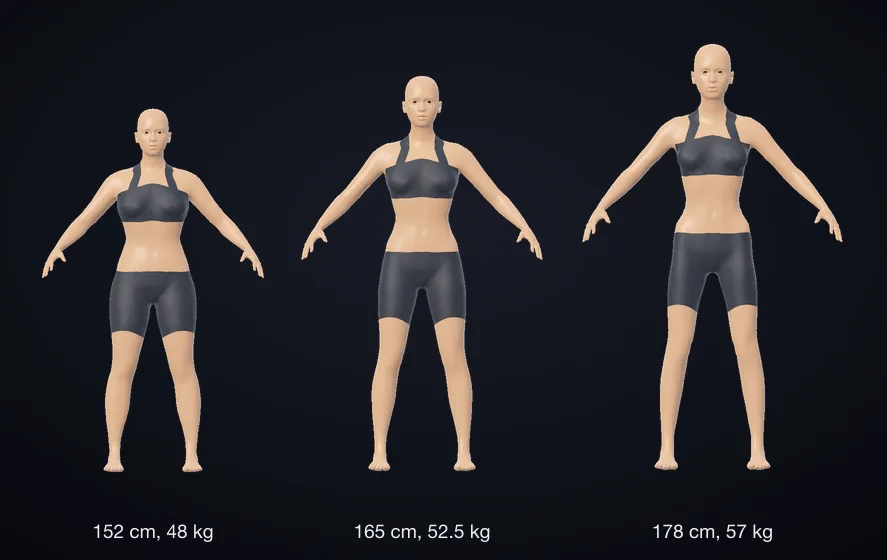
At 165 cm (about 5 ft 5 in) the model reached all three numbers at every weight from 45 to 60 kg, tried in 1 kg steps. Outside that range it could not hold the weight with those girths. The figure drawn weighs 52.5 kg (116 lb), the weight at which the model's hips measure 91.4 cm with nothing set. At that weight the model's own bust is 84.3 cm and its waist 67.0 cm. Reaching 36-24-36 took 6.0 cm off the waist and added 7.1 cm to the bust.
Within the range, the extra weight goes to the limbs. The model's thigh measures about 30 cm at 46 kg and about 56 cm at 60 kg, with the same bust, waist and hips.
| Height | Weights that reach the numbers | Figure drawn | BMI of figure drawn | Waist to height ratio |
|---|---|---|---|---|
| 152 cm (about 5 ft 0 in) | 40 to 52 kg (88 to 115 lb) | 48 kg (106 lb) | 20.8 | 0.40 |
| 165 cm (about 5 ft 5 in) | 45 to 60 kg (99 to 132 lb) | 52.5 kg (116 lb) | 19.3 | 0.37 |
| 178 cm (about 5 ft 10 in) | 51 to 67 kg (112 to 148 lb) | 57 kg (126 lb) | 18.0 | 0.34 |
These weights come from the volume of a model, and no measured group of women stands behind them. At 178 cm the figure drawn has a BMI of 18.0, inside the CDC's underweight category of less than 18.5. A 61 cm waist is 0.37 of a 165 cm height, lower than the 0.4 where the waist to height bands in the NICE guideline begin. A doctor or nurse can assess what a waist or a weight means for one person's health.
To see the three numbers at your own height, enter them in the 3D body visualizer.