To take body measurements at home, stand upright in light clothing with your feet together. Keep a soft tape level and snug without pressing into the skin. Tape the bust around the fullest part of the chest. Tape the waist midway between the lowest rib and the top of the hip bone, at the end of a normal breath out. Tape the hips around the widest part of the buttocks. Those positions come from the measuring manuals of the WHO, the CDC, ISO and the US Army.
The 12 tape positions
| Measurement | Where the tape goes | Mistake to avoid |
|---|---|---|
| Bust or chest | Level around the fullest part, over the shoulder blades and under the armpits | Pressing the tape into soft tissue; a padded bra |
| Underbust | Level around the ribcage directly under the breasts | Tape not level front to back |
| Waist | Midway between the lowest rib and the top of the hip bone | Holding the stomach in |
| Hips | Level around the widest part of the buttocks | Tape dipping at the back; bulky clothes |
| Neck | Around the neck at the Adam's apple, at right angles to the neck | Head tilted instead of level |
| Shoulders | From one bony shoulder tip to the other | Shrugging or shifting the shoulders |
| Upper arm | Halfway between shoulder tip and elbow tip, arm hanging loose | Flexing the muscle |
| Thigh | Where the thigh meets the buttock, at right angles to the leg | Tensing the thigh; tape in the crease |
| Calf | Level around the widest part of the calf | Stopping at one reading |
| Inseam | Crotch to floor in a straight line, feet slightly apart | Weight on one leg |
| Torso, back length | From the bony bump at the base of the neck down the spine to waist level | Slack tape lifting off the back |
| Height | Floor to top of the head, heels together | Shoes on, or hair piled on top |
Before you measure: tape, clothes and posture
- Use a flexible tape that does not stretch. The WHO asks for a stretch-resistant tape, and the clothing standard ISO 3635 for a dimensionally stable one about 15 mm wide.
- Measure on bare skin or over light clothing. The WHO manual rules out thick or bulky clothing. ISO 3635 takes the bust over an unpadded bra of thin material.
- Stand with your feet together, your weight on both feet and your arms relaxed at your sides.
- Pull the tape snug but not tight enough to compress the skin. Use a mirror to check that it is level front and back, as CDC examiners do.
- Breathe normally. For the waist and hips, read the tape at the end of a normal breath out.
- Measure twice. The WHO report says to average two readings that are within 1 cm of each other, and to repeat both if they are further apart.
Bust, waist and hips, step by step
For the bust, pass the tape over the shoulder blades, under the armpits and across the fullest part of the bust. That is the ISO 3635 definition of bust girth, and a man's chest girth takes the same path. The US Army handbook warns that the tape will press into soft tissue here and says to keep that to a minimum. The underbust is a level girth directly under the breasts.
For the waist, find the lowest rib you can feel and the top of the hip bone on one side. Wrap the tape level around the trunk midway between the two. The UK's NICE guideline gives the same site for measuring at home and notes that it falls a little higher than the belly button.
For the hips, stand with your feet together and wrap the tape level around the widest part of the buttocks. The WHO and ISO 3635 take the hips at the largest girth around the buttocks. The CDC tapes level with the point where the buttocks stick out furthest in side view.
Why the waist has four answers
The word waist means a different tape height in each protocol.
| Protocol | Where the waist tape goes | What it is used for |
|---|---|---|
| WHO STEPS manual; NICE in the UK | Midway between the lowest rib and the top of the hip bone | WHO health surveys; the NICE waist to height ratio |
| NIH guide; CDC survey manual | At the top of the hip bone | NIH waist lines of 35 in and 40 in; CDC average waist sizes |
| ISO 3635 | Natural waistline, between the top of the hip bones and the lower ribs | Clothing sizes |
| US Army survey, 2010 to 2012 | Level with the center of the navel | Sizing Army clothing and equipment |
The sites do not give the same number. A study in the American Journal of Clinical Nutrition taped 49 males and 62 females at four waist sites. In females the narrowest waist read smallest on average. The site just under the lowest rib came next, then the midpoint, and the site just over the hip bone read largest. In males the narrowest waist read smaller than the other three.
Match the site to the use. For a size chart, tape the natural waistline. For a waist to hip ratio by the WHO method or a waist to height ratio by the NICE method, use the midpoint. For the NIH lines of 35 in for women and 40 in for men, tape at the top of the hip bone.
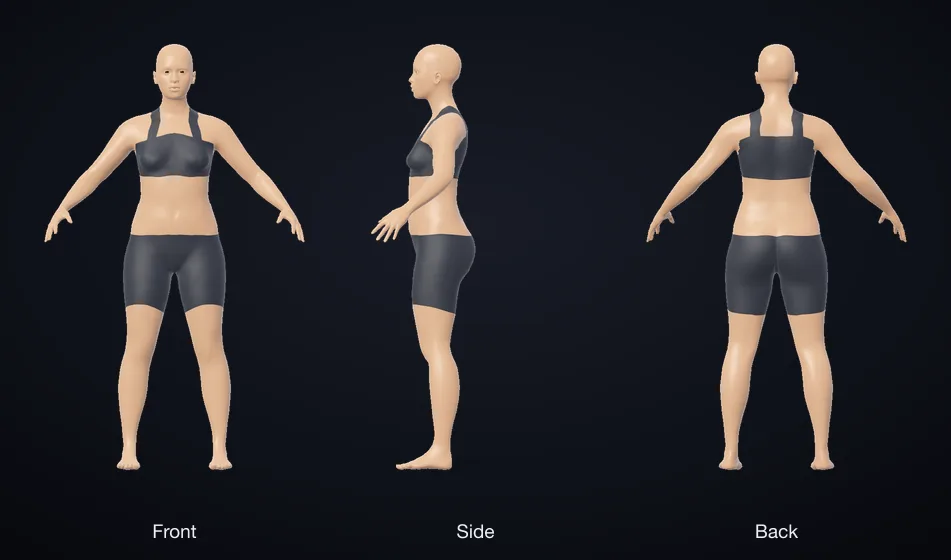
The model in the picture shows how much tape height matters. It is 165 cm tall, with a 76.6 cm waist and 100.2 cm hips, so its waist to hip ratio is 0.76. At the high hip, the largest girth in the top quarter of the way from the waist to the crotch, the tape reads 86.4 cm and the ratio would be 0.89. The WHO cut-off table for women draws its line at 0.85, between the two. Use the midpoint site for the numbers you enter in the waist to hip ratio calculator and the waist to height ratio calculator.
Neck, shoulders and upper arm
Tape the neck at the Adam's apple, at right angles to the length of the neck, with your head level. That is the US Army site. ISO 3635 puts the tape 2 cm lower at the front and level with the seventh neck vertebra at the back.
Shoulder width runs between the bony tips of the two shoulders. The Army takes it in a straight line with a caliper and found a mean of 41.6 cm for men and 36.5 cm for women. A tape laid across the back follows the curve of the body, so it reads longer than a straight line between the same two points. The clothing standard ISO 8559-1 lists that kind of surface measurement as back shoulder width. The Army also tapes a girth around both shoulders at the middle of the deltoid muscles: 117.9 cm for men and 102.8 cm for women on average.
For the upper arm, the CDC bends the elbow to 90 degrees. It marks the midpoint between the bony tip of the shoulder and the tip of the elbow. The arm then hangs loose, and the tape goes around it at the mark. Its manual says that flexing the arm gives an inaccurate measurement. The Army's biceps measurement is the opposite on purpose: elbow bent, fist clenched and the muscle flexed as hard as possible.
Thigh, calf, inseam and torso length
The Army tapes the thigh where it meets the buttock, at right angles to the leg. Stand with your legs just far enough apart that the thighs do not touch, and keep the muscles relaxed. For the calf, the tape goes level around the widest part, and the Army takes three readings around that area.
ISO 3635 calls the inseam inside leg length: the straight-line distance from the crotch to the soles of the feet. Stand with the feet slightly apart and the weight on both legs. The Army measures the same span with a rigid rod raised firmly into the crotch. Its means are 84.6 cm for men and 78.2 cm for women.
Two Army measurements cover torso length. Back length runs down the spine from the bony bump at the base of the neck to waist level. The Army's version ends level with the navel and averages 47.8 cm for men and 42.5 cm for women. The vertical trunk loop runs from the middle of one shoulder down the front, through the crotch and up the back to the same shoulder. Its Army means are 166.5 cm for men and 155.9 cm for women.
How close a careful measurement gets
A tape reading is not exact, even in trained hands. The WHO report quotes a technical error of 1.31 cm when one measurer repeats a waist measurement on adolescents, and 1.56 cm between two measurers. The Army lets its trained measurers differ by up to 12 mm on the waist and hips and 14 mm on the chest. The allowance is 6 mm on the neck and thigh and 4 mm on the calf. A gap of about 1 cm between two readings is within that error.
With bust, waist and hips written down, the body shape calculator names the shape class, and the 3D body visualizer draws a figure from your numbers.