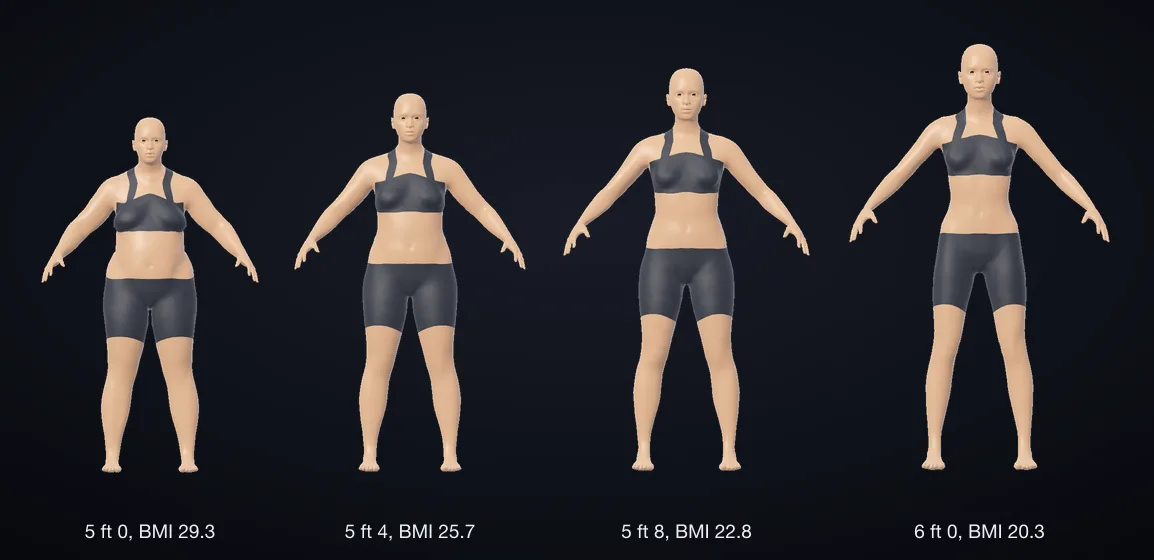
A weight of 150 pounds looks different at every height, because the same 68 kg sits on a shorter or a taller frame. At 5 ft 0 it gives a body mass index (BMI) of 29.3, near the top of the CDC's overweight range. At 6 ft 0 it gives 20.3, well inside the healthy weight range. The same holds at 180 and 200 pounds: the taller the frame, the lower the BMI and the narrower the figure.
150 pounds at four heights
At 150 lb (68 kg) the BMI is 29.3 at 5 ft 0 and 25.7 at 5 ft 4. It is 22.8 at 5 ft 8 and 20.3 at 6 ft 0. The first two values fall in the CDC's overweight range, 25 to less than 30. The last two fall in the healthy weight range, 18.5 to less than 25.
On the female figures the waist narrows from 94.6 cm (37.2 in) at 5 ft 0 to 71.9 cm (28.3 in) at 6 ft 0. The hips change less, from 108.4 cm to 99.2 cm. The weight is the same in all four. It is spread along 12 more inches of height.
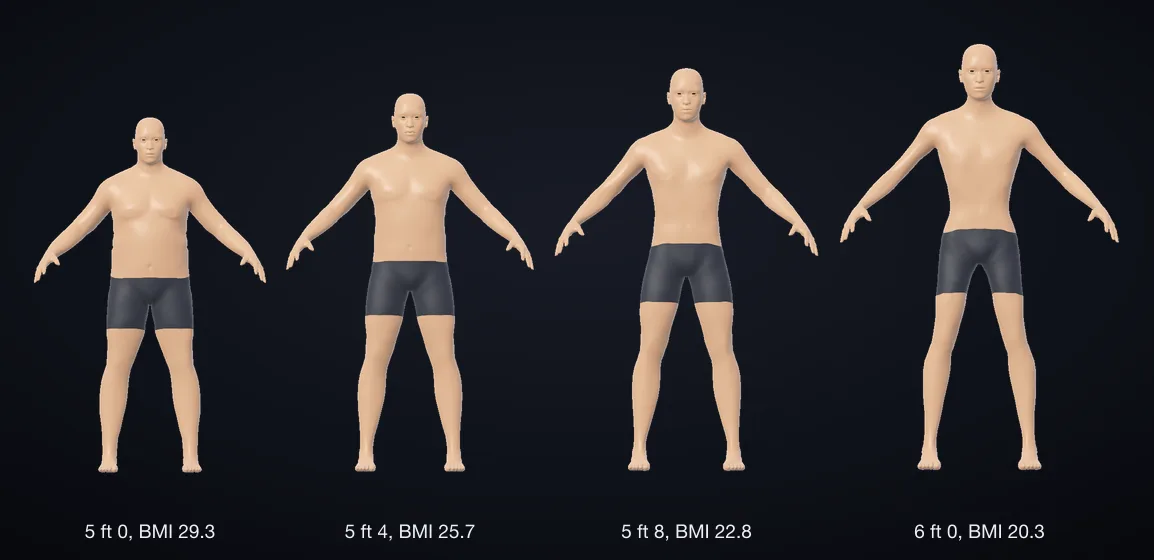
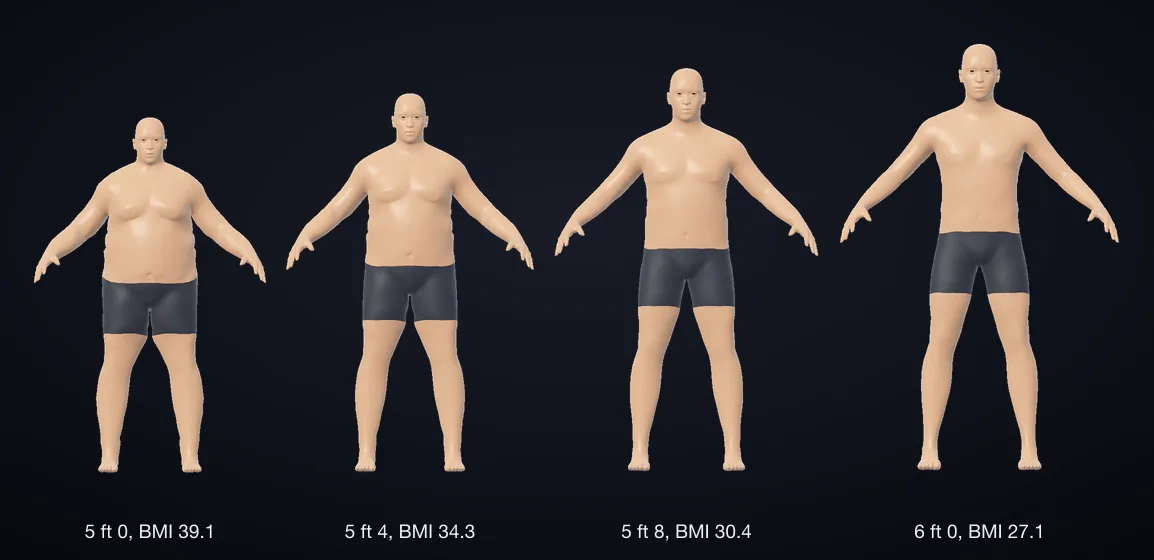
The male figures at 150 lb follow the same line. The waist drawn is 94.8 cm at 5 ft 0 and 87.1 cm at 5 ft 4. At 5 ft 8 it is 77.1 cm, and at 6 ft 0 it is 70.6 cm.
180 pounds at four heights
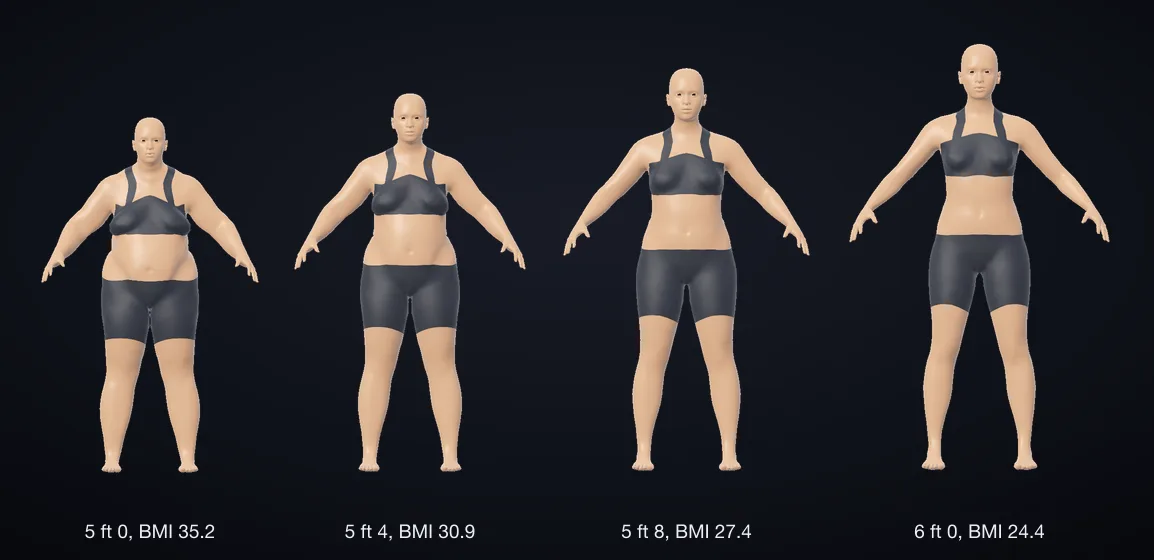
At 180 lb (82 kg) every 4 inches of height moves the result one step along the CDC's table. The BMI is 35.2 at 5 ft 0, which is class 2 obesity, and 30.9 at 5 ft 4, which is class 1 obesity. At 5 ft 8 it is 27.4, overweight, and at 6 ft 0 it is 24.4, healthy weight.
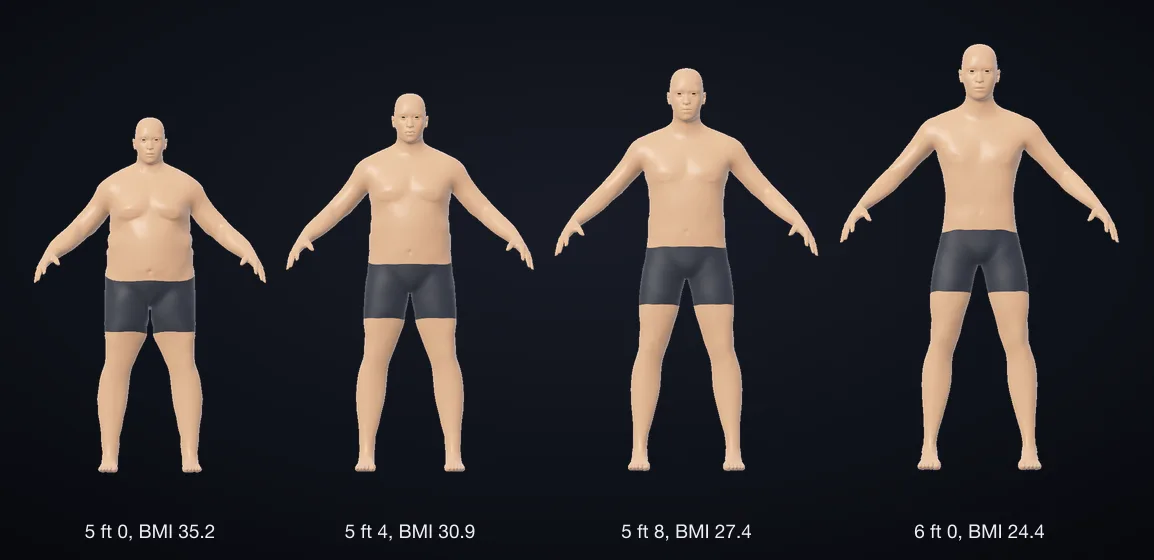
The waist drawn at 180 lb runs from 112.2 cm at 5 ft 0 to 83.0 cm at 6 ft 0 on the female figures. On the male figures it runs from 107.9 cm to 83.1 cm.
200 pounds at four heights
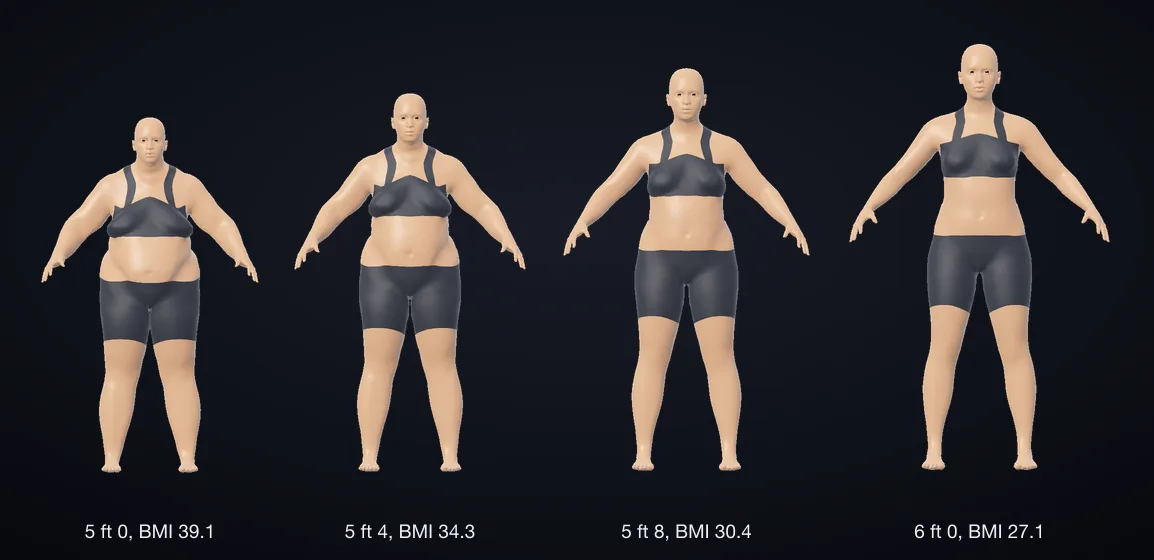
At 200 lb (91 kg) the BMI is 39.1 at 5 ft 0 and 34.3 at 5 ft 4. Both are in the CDC's obesity range, class 2 and class 1. At 5 ft 8 it is 30.4, just inside class 1 obesity, which starts at 30. At 6 ft 0 it is 27.1, overweight.
Two hundred pounds is also about what the average American man weighs. The figure comes from the National Health and Nutrition Examination Survey of 2015 to 2018. Its average man weighed 199.8 lb and stood 69.0 in, which is 5 ft 9. At 5 ft 9, 200 lb is a BMI of 29.5. The average woman in the same survey weighed 170.8 lb and stood 63.5 in.
BMI by height for 140 to 200 pounds
| Height | 140 lb | 150 lb | 160 lb | 180 lb | 200 lb |
|---|---|---|---|---|---|
| 5 ft 0 | 27.3 | 29.3 | 31.2 | 35.2 | 39.1 |
| 5 ft 2 | 25.6 | 27.4 | 29.3 | 32.9 | 36.6 |
| 5 ft 4 | 24.0 | 25.7 | 27.5 | 30.9 | 34.3 |
| 5 ft 6 | 22.6 | 24.2 | 25.8 | 29.0 | 32.3 |
| 5 ft 8 | 21.3 | 22.8 | 24.3 | 27.4 | 30.4 |
| 5 ft 10 | 20.1 | 21.5 | 23.0 | 25.8 | 28.7 |
| 6 ft 0 | 19.0 | 20.3 | 21.7 | 24.4 | 27.1 |
| 6 ft 2 | 18.0 | 19.3 | 20.5 | 23.1 | 25.7 |
| 6 ft 4 | 17.0 | 18.3 | 19.5 | 21.9 | 24.3 |
Each value comes from the CDC formula for pounds and inches: weight divided by height squared, times 703. For 200 lb at 5 ft 8 (68 in), that is 200 divided by 4,624, times 703, which gives 30.4.
The CDC sorts adults aged 20 and older into four categories. Underweight is a BMI of less than 18.5. Healthy weight is 18.5 to less than 25. Overweight is 25 to less than 30. Obesity is 30 or greater. It has three classes: class 1 is 30 to less than 35, class 2 is 35 to less than 40 and class 3 is 40 or greater.
Is 200 pounds overweight at 5 ft 8, or 140 pounds at 5 ft 4
At 5 ft 8, 200 lb is a BMI of 30.4. That is past the overweight range and in the CDC's obesity category, class 1. At that height the overweight range runs from 165 to 196 lb.
At 5 ft 4, 140 lb is a BMI of 24.0, inside the healthy weight range. The overweight range at 5 ft 4 starts at 146 lb, and 150 lb gives a BMI of 25.7.
| Height | Healthy weight | Overweight | Obesity |
|---|---|---|---|
| 5 ft 0 | 95 to 127 lb | 128 to 153 lb | 154 lb or more |
| 5 ft 2 | 101 to 136 lb | 137 to 163 lb | 164 lb or more |
| 5 ft 4 | 108 to 145 lb | 146 to 174 lb | 175 lb or more |
| 5 ft 6 | 115 to 154 lb | 155 to 185 lb | 186 lb or more |
| 5 ft 8 | 122 to 164 lb | 165 to 196 lb | 197 lb or more |
| 5 ft 9 | 125 to 168 lb | 169 to 202 lb | 203 lb or more |
| 5 ft 10 | 129 to 173 lb | 174 to 208 lb | 209 lb or more |
| 6 ft 0 | 137 to 183 lb | 184 to 220 lb | 221 lb or more |
| 6 ft 2 | 144 to 194 lb | 195 to 233 lb | 234 lb or more |
| 6 ft 4 | 152 to 204 lb | 205 to 246 lb | 247 lb or more |
The 5 ft 9 row is the example the CDC itself prints for an adult of that height. The other rows are worked out the same way, in whole pounds with BMI rounded to one decimal place.
What a weight and a BMI cannot show
BMI is a screening measure, in the CDC's words, and is not meant to diagnose disease. BMI does not distinguish between fat, muscle and bone, and it does not show where on the body fat is carried. Two people at 5 ft 8 and 180 lb share a BMI of 27.4 and can still have different shapes.
To see your own numbers as a figure, enter your height and weight in the 3D body visualizer. For the category your BMI falls in, use the BMI visualizer. The WHO uses the same cut-offs as the CDC, and NICE sets lower ones for some groups. The adult BMI categories and their limits gives the numbers from each organization. For what your weight means for your own health, ask a doctor or nurse.